Skick
For more information please contact victoria.svederberg@auktionsverket.com.
Utläst automatiskt ur husets skickbeskrivning.
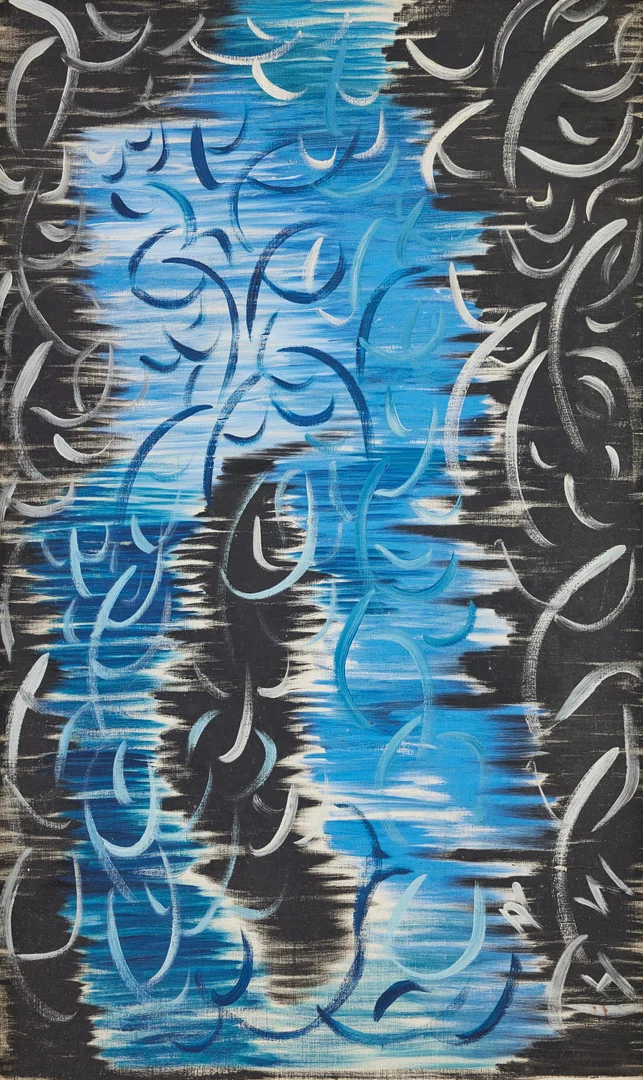
Oil and tempera on canvas, 100 x 60 cm, including frame 113 x 72.5 cm. Signed with monogram NWH. Signed and titled on the reverse Nell Walden-Heimann “Blue”. Inscribed on the stretcher: “N° 45 1927" and “153". Executed in April 1927. Stockholms Auktionsverk would like to thank Jessica Sjöholm Skrubbe for valuable help in cataloguing this lot. PROVENANCE Gift directly from the artist to the current owner's family. EXHIBITED Berlin, Grosse Berliner Kunstausstellung, 7 May - 30 September 1927, cat. no. 488. Kunstmuseum Bern, "Der Sturm, Sammlung Nell Walden aus den Jahren 1912–1920", October 1944–Mars 1945, cat. no. 390. Kunsthaus Zürich, "Expressionisten, Kubisten, Futuristen: Sammlungen Nell Walden und Dr. Othmar Huber", 19 May –17 June 1945, cat. no. 153. Gewerbemuseum Aarau, "Sammlung Nell Walden: Sonderausstellung Nell Walden", 17 November-8 December 1957, cat. no. 7. LITERATURE The work is included in the artist's oeuvre catalogue. Nell Walden (born Nelly Roslund, 1887—1975) was a Swedish-Swiss artist, writer and cultural mediator, active at the center of European avant-gardism in the early 20th century. She is best known for her significant role in the expressionist movement Der Sturm, where she served as an artist, benefactor and editor alongside her then husband, the German gallerist and publisher Herwarth Walden. Nell Walden grew up in Sweden, where her interest in art was encouraged early on, including by her maternal grandfather who was an important figure during her upbringing. She studied art and subsequently traveled around Europe. During a stay in Germany, she met Herwarth Walden — an encounter that would have crucial bearing on her life and career. They married in 1912, the same year that Der Sturm gallery in Berlin was established as an important platform for the most innovative artists of the time. Through her involvement with Der Sturm, Nell Walden came into contact with some of modernism's most influential figures, such as Wassily Kandinsky, Paul Klee, Marc Chagall and Gabriele Münter. She was not only an important mediator of art, but also developed her own artistry within the framework of the movement. Her painting is characterized by abstract, colorful compositions, often with elements of cubism, expressionism and lyrical naivism. She was inspired by music, dreams and emotional expressions, which gave her works an intuitive and spontaneous character. A pivotal moment in her artistic development occurred in 1914 during a visit with Kandinsky and Münter in Murnau, southern Germany. There she came into contact with hinterglasmalerei — traditional paintings on glass with strong colours and folk character. The experience made a deep impression on her, and she herself began experimenting with the technique, encouraged by Kandinsky and Münter. After Der Sturm's dissolution, Nell Walden continued to operate as an artist and writer. She developed an independent artistic style and became one of the few women in the otherwise male-dominated avant-garde scene who also left a lasting imprint. In the latter part of her life, she returned to Sweden, where she continued to paint and write, while also engaging in documenting and preserving the legacy of Der Sturm. Nell Walden was a versatile and visionary cultural personality whose work extended far beyond her own artistry. She was an important bridge-builder between artists, currents of ideas and the audience — and between the radical ideas of early modernism and the free artistic expression of the future. Her work has received increased attention in retrospect, not least as an example of female leadership and artistic courage in a time of great change. Has resale rights.