Avslutad
Utagawa Kuniyoshi
Utagawa Kuniyoshi · Stockholms Auktionsverk Magasin 5 · Stockholm
41 bud
Skick
Age-related wear and surface dirt, handling creases. Colours overall in good condition. For any questions, please contact lisa.mejeritcher@stockholmsauktionsverk.com.
Utläst automatiskt ur husets skickbeskrivning.
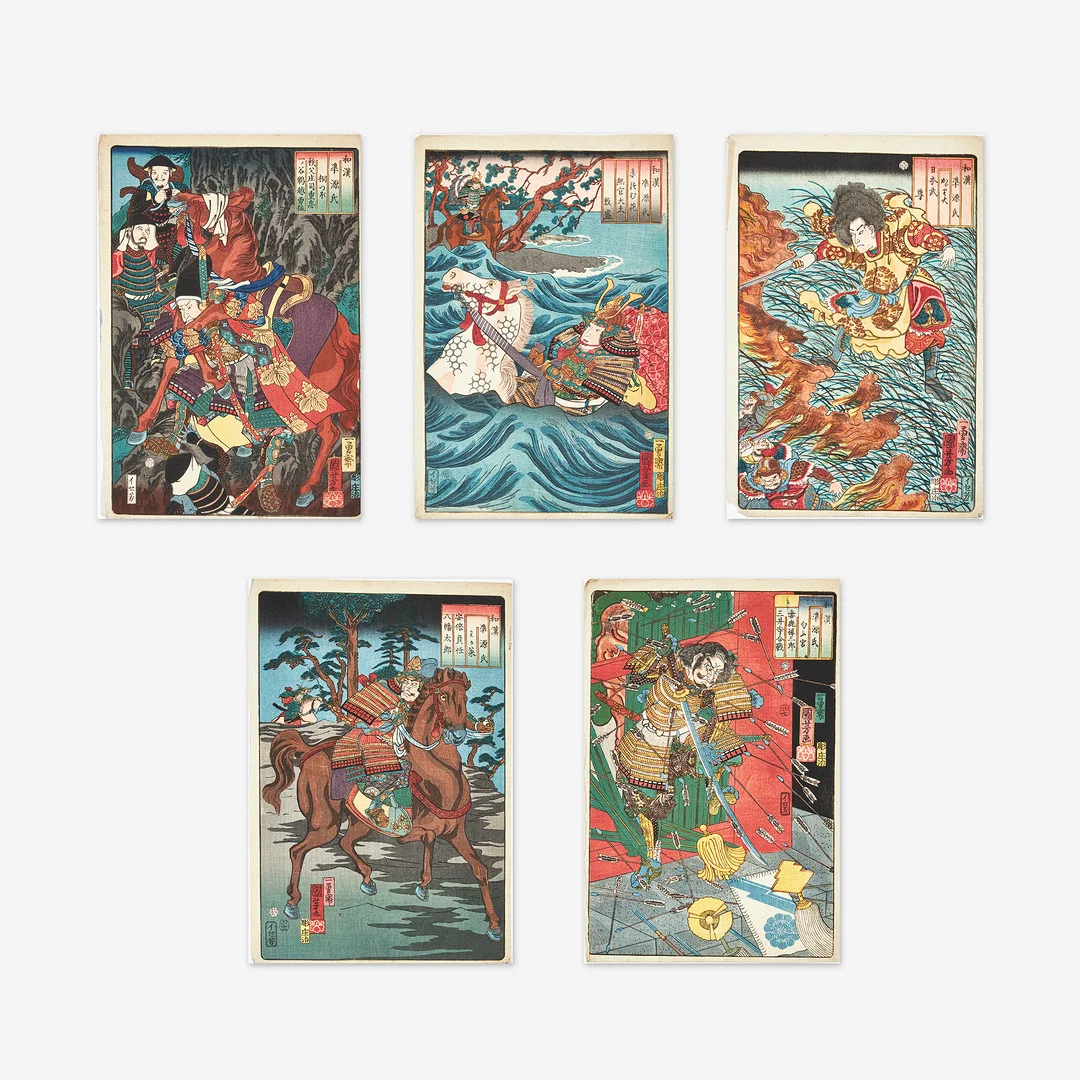
CHAPTER ONE, Paulownia Court, 桐壺, (Kiritsubo) Woodblock print in colours, 38 x 26 cm. Published by Ise-Yoshi, 1855-1856. Depicting Chichibu Shôji Shigetada (秩父荘司重忠) carrying his blindfolded horse down the steep hill at Hiyodori-goe. LITTERATURE Robinson S88.1 CHAPTER SIX, The Saffron Flower, 末摘花, (Suetsumuhana) Woodblock print in colours, 38 x 26 cm. Published by Ise-Yoshi, 1855-1856. Depicting Mukwan no Tayû Atsumori (無官太夫 敦盛) riding out to sea at Ichi-no-tani while Kumagae Naozane (熊谷直實) hails him from shore. LITTERATURE Robinson S88.6 CHAPTER TWENTY-SEVEN, Flares, 篝火, (Kagaribi) Woodblock print in colours, 38 x 26 cm. Published by Ise-Yoshi, 1855-1856. Depicting Yamatotakeru-no-mikoto (日本武 尊) using his “grass-mowing sword” to foil an attempt to trap him in burning grass. LITTERATURE Robinson S88.27 CHAPTER THIRTY-FOUR, New Herbs, Part I, 若菜上, (Wakana no jô) Woodblock print in colours, 38 x 26 cm. Published by Ise-Yoshi, 1855-1856. Depicting Abe no Sadatô (安倍 貞任) being pursued by Hachiman-tarô Yoshi-ie (八幡太郎義家), both on horseback. LITTERATURE Robinson S88.34 CHAPTER FORTY-TWO, His Perfumed Highness, 匂宮, (Niônomiya) Woodblock print in colours, 38 x 26 cm. Published by Ise-Yoshi, 1855-1856. Depicting Mega Magosaburô (妻鹿 孫三郎) at the Battle of Miidera defending the gateway amid a hail of arrows. LITTERATURE Robinson S88.42 The Tales of Genji (Genji monogatari) is regarded as the foremost novel of classical Japanese literature and is often considered the world’s first novel. It was written by Lady Murasaki during the early eleventh century. In this series, Kuniyoshi juxtaposed episodes drawn from history, literature, and legend with corresponding chapters from the novel. PROVENANCE The collection of Dr Eugen Milch (1889-1958), Austrian physician and artist. During the First World War he practiced as a medical officer. Milch was a true globetrotter - in the early 1920s, he travelled across Europe on a combined study and painting tour. In 1924, he married Emma Bormann, and the couple visited Sweden that same year. Together with the artist Oskar Bergman, they exhibited a number of paintings at Liljevalchs in Stockholm. In 1937, Eugen left for China with other Austrian physicians at the invitation of the Chinese government, and was joined by his wife two years later. The initial posting didn’t materialize, but in 1938 he became superintendent of a hospital in Beihai, China. In 1941, when Japanese forces occupied part of the South China coast, including Beihai, the Milch family managed to move to Shanghai. While in China, Eugen and Emma decided to separate. Eugen went on to assist British forces in China, for which he was awarded British citizenship. Continuing his travels, he went to Japan to study the aftermath of the war, and this is where he probably acquired the present collection of Japanese woodblock prints. He died in Hong Kong in 1958. Thence by descent within the family.