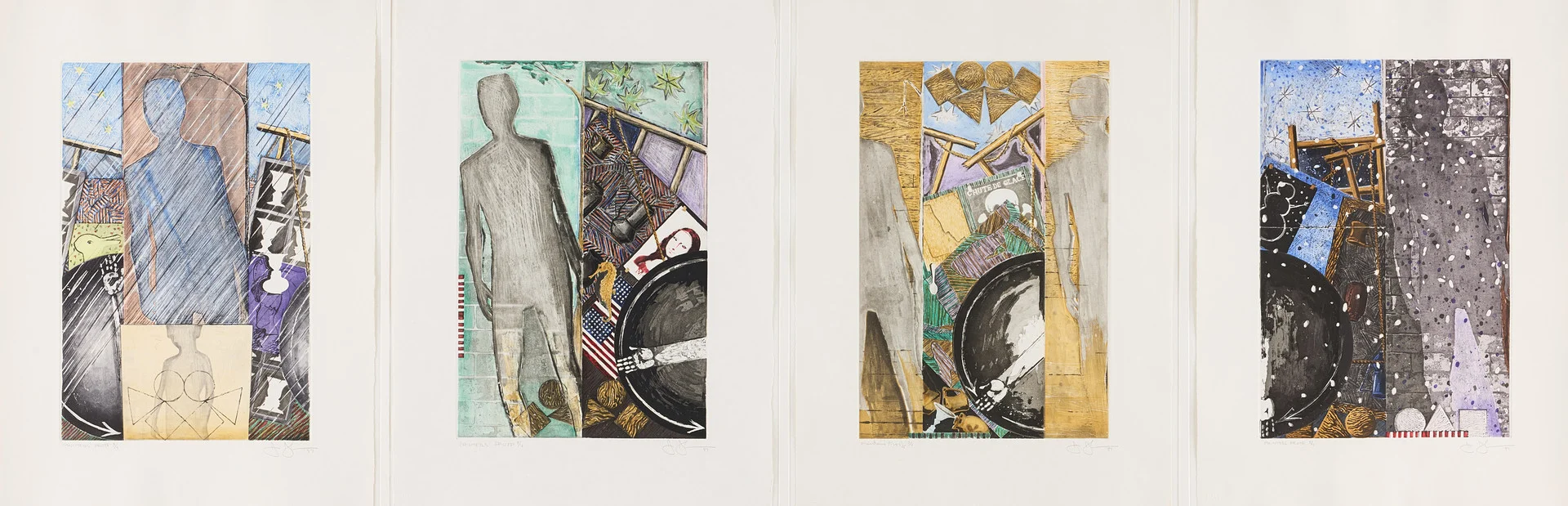
Jasper Johns · "The Seasons"
Jasper Johns · Stockholms Auktionsverk Fine Art · Stockholm
2 bud
Skick
Each sheet with full margins, the sheets float mounted and archivally hinged at the verso corners, overall in good condition. For questions, please contact fredrik.fellbom@auktionsverket.se.
Utläst automatiskt ur husets skickbeskrivning.
The complete set of four colour etchings with aquatint on Somerset wove paper, 1987. One of four numbered printer's proofs sets, aside from the edition of 73. Each of four sheets signed, dated, inscribed, and numbered J. Johns '87 Printer's Proof 3/4. Printed and published by ULAE, West Islip, New York, with the blind stamps. Each I. 49.3 x 32.7 cm, S. 67 x 48.9 cm. With frame 228 x 97 cm. ULAE 238-241. Jasper Johns (born May 15, 1930) is an American painter, sculptor, draftsman, and printmaker. He is considered a central figure in the development of American postwar art, he has been variously associated over his many decades long career with Abstract Expressionism, Neo-Dada, and Pop Art movements. Johns was born in Augusta, Georgia, and later attended art school at the Parsons School of Design in New York. His art studies were interrupted by military service during the Korean War, and he returned to New York in 1953, During the mid-1950s he began associations with key figures in the art world, including Robert Rauschenberg, with whom he had a romantic relationship until 1961. The two were also close collaborators, and Rauschenberg provided a profound artistic influence and notable contacts with significant individuals in the New York art scene at the beginning of Johns' artistic profession. In March 1957, while visiting Rauschenberg's studio which was adjacent to Johns', the prominent New York gallery owner (and Rauschenberg's representative at the time) Leo Castelli asked to see Johns's art. Castelli was astounded with the array of works he viewed in Johns' studio, he later recalled, "There was a fantastic display of flags and targets . . there was a big white flag, a smaller white flag, numbers, the alphabet, anything—all those great masterpieces." These paintings of flags, maps, targets, letters, and numbers, for which Johns became so recognized, are groundbreaking works of postwar art which upended the course of contemporary art. Castelli offered Johns an exhibition, and organized his first solo show. Held in early 1958, the exhibition was positively received; all but two of the eighteen works on view sold. Alfred H. Barr Jr., the founding director of New York's Museum of Modern Art, purchased three paintings from the show, which were the first works by Johns to enter a museum collection. Johns' career and artistic acclaim continued its ascent through the next several decades of the 20th century. In 1973, the architect Philip Johnson, under the guidance of Alfred H. Barr, bought John's early encaustic painting "Flag", 1954-55, and donated it to the Museum of Modern Art, New York. It is an icon of both American and postwar art and remains one of Johns's most enduring motifs; over the course of the proceeding fifty years he produced more than twenty-seven paintings, ten sculptures, fifty drawings, and eighteen print editions that depict the form of the American flag as the primary image. It has been reported that one of his "Flag" paintings, which he painted in 1958, sold for greater than one hundred million dollars to a private collector in 2010, becoming the most expensive artwork sold by a living artist. Among numerous other honors, Johns received the Golden Lion at the Venice Biennale in 1988, the National Medal of Arts in 1990, and the the Presidential Medal ofFreedom in 2011 from President Barack Obama, becoming the first painter or sculptor to receive a Presidential Medal of Freedom since Alexander Calder in 1977 The Metropolitan Museum of Art, New York, which holds a set of "The Seasons: Spring, Summer, Fall, Winter", notes that, "These four prints of 'The Seasons' explore artifacts and seasonal symbols to represent the epochs of life and the cycles of growth and aging. The works review many motifs used previously in Johns's work--[for instance] the arm in a partial circle rotates like a clock through these panels. Optical illusions such as duck / rabbit or old woman / young woman in 'Spring' explore the nature of seeing and experiencing. In 'Fall', a profile of Marcel Duchamp (a spiritual and artistic mentor to Johns) is included next to a skull and crossbones from a Swiss sign warning of avalanche danger, a reminder of mortality. 'The Seasons' also incorporates elements of more reflective imagery that emerged in his work in the 1980s. A scaled down version of the artist's own shadow refers to Johns's meditation on his own path." The Courtauld Gallery, London, which received a set of "The Seasons" from the widow of the gallery owner Leo Castelli, the only museum in the United Kingdom to have such a comprehensive group of these prints in its collection, adds that there is an overarching autobiographical and career retrospective facet to the series, "'The Seasons' are rich and complex works, weaving together themes relating to artistic creation, the passage of time and the artist’s own biography. Most prominently, Johns’ shadow appears in each of the compositions, cast across the multi-layered imagery. Printmaking is one of Johns’ major preoccupations and this display reveals how he uses an array of techniques to create a collaging of imagery that is both evocative and mysterious.".