Skick
Not examined out of frame. For further questions, please contact cecilia.berggren@auktionsverket.com.
Utläst automatiskt ur husets skickbeskrivning.
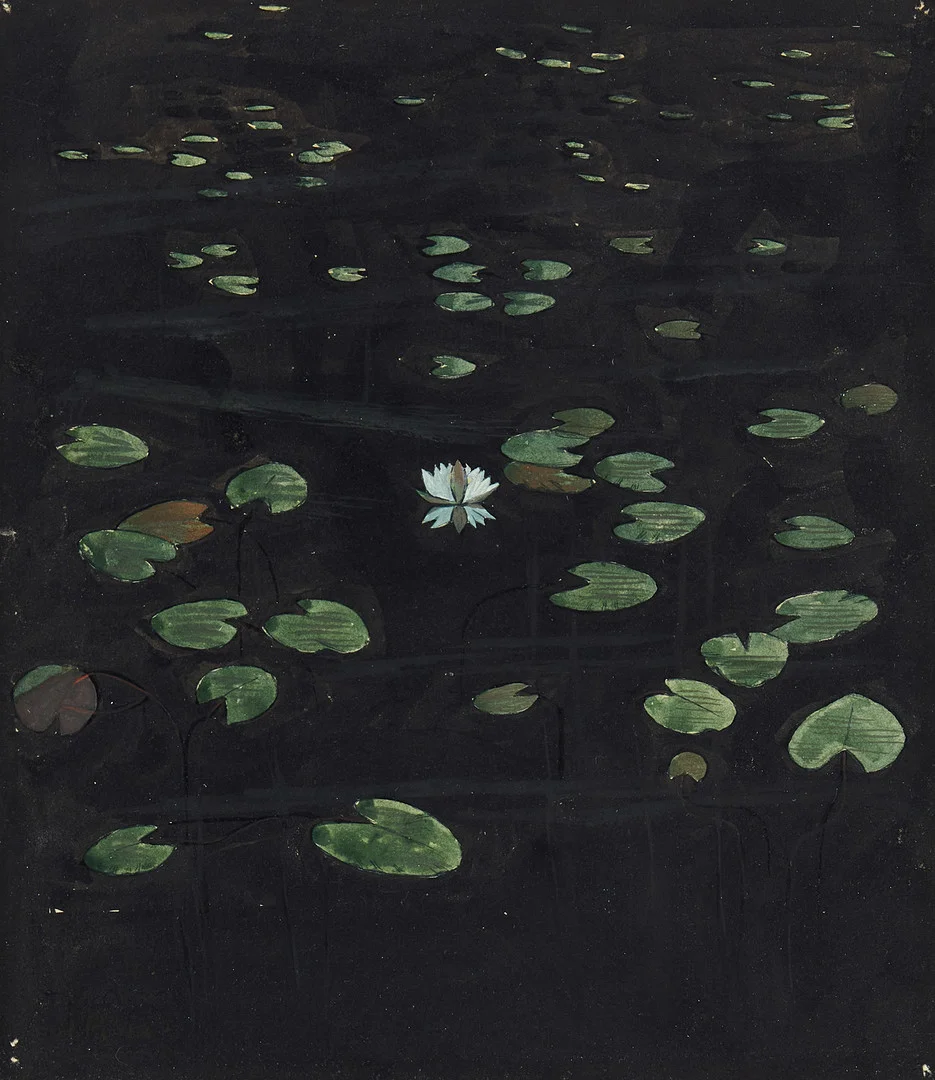
Gouache and pencil on paper, 23.3 x 20.3 cm, including frame 45 x 42 cm. Monogram signed and dated IA 02. Inscribed on the reverse in Swedish: ”Svarttjärn, Torsby Fryksände målat av Ivar Arosenius”. A tergo study of a grove of trees. PROVENANCE Uppsala Auktionskammare, Klassiska, 16 June 2020, no. 85. The motif is taken from the lake Svarttjärn in Fryksände parish north of Torsby in Värmland. In the summer of 1902, Arosenius traveled with his friend and future brother-in-law, the architect and furniture designer Ernst Spolén, from Gothenburg to his parents' home in Torsby, Värmland. In 1906, Spolén would marry Ivar's sister, Ingegerd. The bohemian circle in Gothenburg also included female artists, among them the actress Ester Sahlin (1881-1959). With her cheerful, positive personality, she became a counterbalance to the group's destructive side and won the hearts of several of the male members. But it was with Arosenius that she began a relationship. During the time the two were a couple, and for some time thereafter, Ester Sahlin was Arosenius's most recurring motif. Both in the good and difficult moments of the relationship, she was depicted, tenderly and lovingly or coldly and bitterly. The paintings of loneliness as longing for love were created almost exclusively during Arosenius's relationship with Ester Sahlin in the years 1902 and 1903. Visually, the current artwork depicts a forest tarn. With knowledge of Arosenius's inner emotional life during this period of his life, however, the motif takes on another, more profound meaning. During his stay in Torsby in the summer of 1902, Arosenius painted the watercolor Värmland and Skåne, his most typical image of longing for love, that for the unattainable woman. The picture, which depicts Arosenius and Ester Sahlin, was sent from Värmland by letter to Sahlin, who at the time was in Skåne. In the foreground of the painting, Arosenius is depicted half-lying and crying, reaching out his hand towards Sahlin. She, however, is on the other side of a body of water and is walking away from the artist, seemingly without seeing him. In the picture, the water is shown as a marker of distance in a very clear way. The distance between them is further reinforced by the text on the shore where Arosenius is located, ”Värmland", and on Sahlin's side ”Skåne". Arosenius's shore is in shadow and is overgrown with thistles and nettles; the weeping artist himself is dressed entirely in black. Sahlin, on the other hand, walks across a flower-filled meadow bathed in sun. Her red dress becomes a symbol of love in the picture. The white water lilies growing at the water's edge where Sahlin stands are another interesting detail. The white water lily could have several different meanings in the symbolic language that emerged within the 1890s symbolist tradition. The most common meaning, and the one that best contributes to the understanding of this work, is the water lily as a symbol of a sexuality linked to female attraction. The inclusion of the water lilies in the picture thus means that the longing for love depicted should not be seen as purely spiritual but also with an erotic undertone. In the images of loneliness as longing for love and as vulnerability, a hopelessness and an inability to make contact are often expressed, with a strong affinity to the author Gustaf Fröding. The alienation Fröding experienced is mixed in Arosenius with Friedrich Nietzsche's ideal of the genius, where alienation becomes a necessity and a source of pride. Nietzsche's influence is most clearly noticeable during the first part of Arosenius's bohemian period, the years up to and including 1903, while the influences from Fröding remain throughout his entire artistic career.