Ended
Utagawa Hiroshige
Utagawa Hiroshige · Stockholms Auktionsverk Magasin 5 · Stockholm
17 bids
Condition
Surface dirt and some staining. Handling crease and wear along the sheets' edges. For any questions, please contact lisa.mejeritcher@stockholmsauktionsverk.com.
Read automatically from the house's condition description.
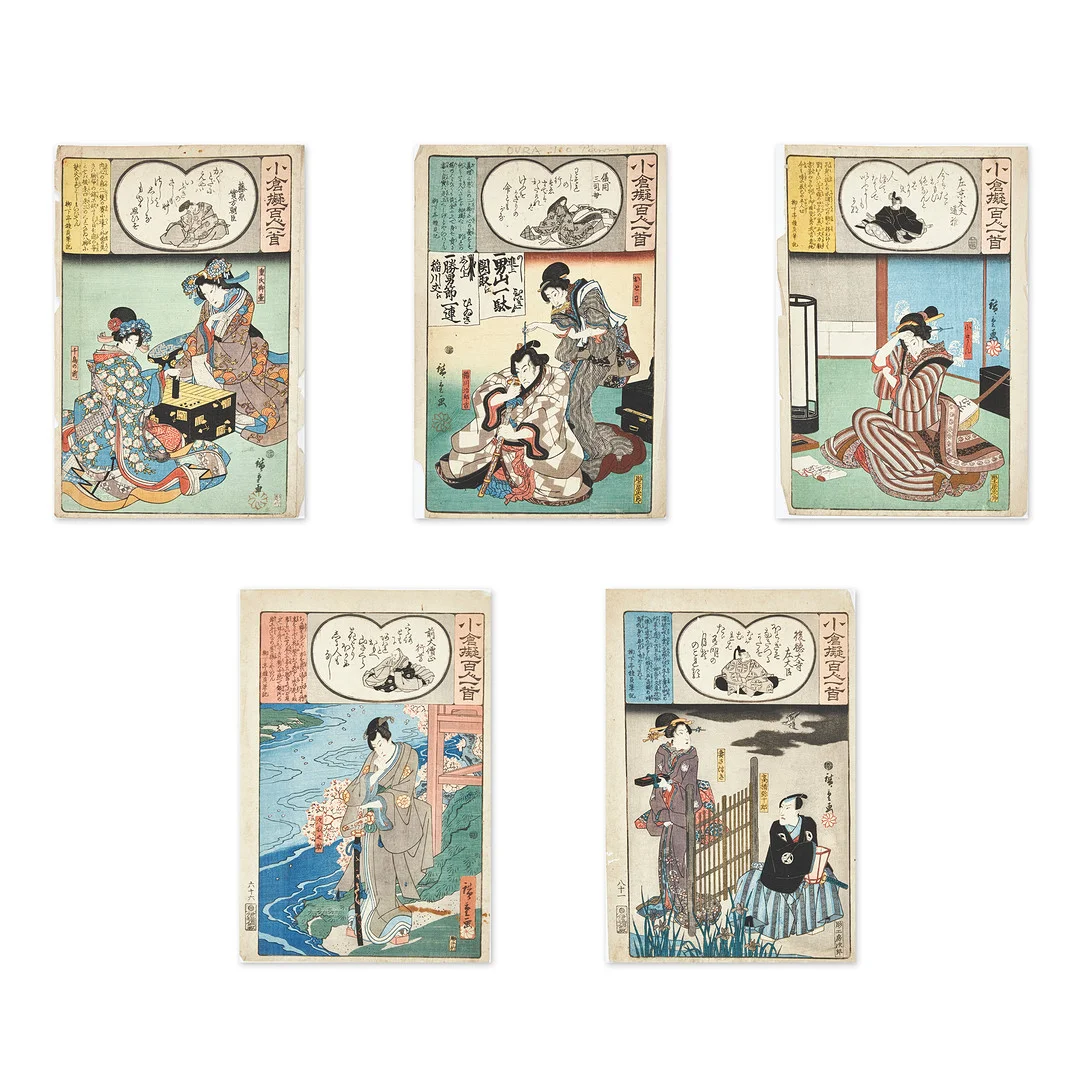
Poem by Fujiwara Sanekata Ason, 藤原実方朝臣 重氏御代 千鳥の前 (Shigeuji's Wife and Chidori no mae). Woodblock print in colours, 36 x 25 cm, ca 1845-1848. Published by Ibaya Senzaburō (Dansendō). "How can I tell her How fierce my love for her is? Will she understand That the love I feel for her Burns like Ibuki's fire plant?" Poem by the Mother of Gidō Sanshi, 儀同三司母 おとわ 稲垣次郎吉 (Otowa and Inagaki Jirokichi). Woodblock print in colours, 35,7 x 26 cm, ca 1845-1848. Published by Ibaya Senzaburō (Dansendō). "If remembering me Will for him in future years Be too difficult, It would be well this very day That I should end my life." Poem by Fujiwara no Michimasa. Woodblock print in colours, 35,7 x 25,3 cm, ca 1845-1848. Published by Ibaya Senzaburō (Dansendō). "Is there any way Except by a messenger To send these words to you? If I could, I'd come to you To say goodbye forever." Poem by Daisōjō Gyōson, Kuganosuke, 大僧行尊 久我之助. Woodblock print in colours, 37,2 x 25,4 cm, ca 1845-1848. Published by Ibaya Senzaburō (Dansendō). "On a mountain slope, Solitary, uncompanioned, Stands a cherry tree. Except for you, lonely friend, To others I am unknown." Poem by Fujiwara no Sanesada. Woodblock print in colours, 37,2 x 25,4 cm, ca 1845-1848. Published by Ibaya Senzaburō (Dansendō). "When I turned my look Toward the place where I had heard The cuckoo's call, The only thing I found Was the moon of early dawn." PROVENANCE The collection of Dr Eugen Milch (1889-1958), Austrian physician and artist. During the First World War he practiced as a medical officer. Milch was a true globetrotter - in the early 1920s, he travelled across Europe on a combined study and painting tour. In 1924, he married Emma Bormann, and the couple visited Sweden that same year. Together with the artist Oskar Bergman, they exhibited a number of paintings at Liljevalchs in Stockholm. In 1937, Eugen left for China with other Austrian physicians at the invitation of the Chinese government, and was joined by his wife two years later. The initial posting didn’t materialize, but in 1938 he became superintendent of a hospital in Beihai, China. In 1941, when Japanese forces occupied part of the South China coast, including Beihai, the Milch family managed to move to Shanghai. While in China, Eugen and Emma decided to separate. Eugen went on to assist British forces in China, for which he was awarded British citizenship. Continuing his travels, he went to Japan to study the aftermath of the war, and this is where he probably acquired the present collection of Japanese woodblock prints. He died in Hong Kong in 1958. Thence by descent within the family.