Avslutad
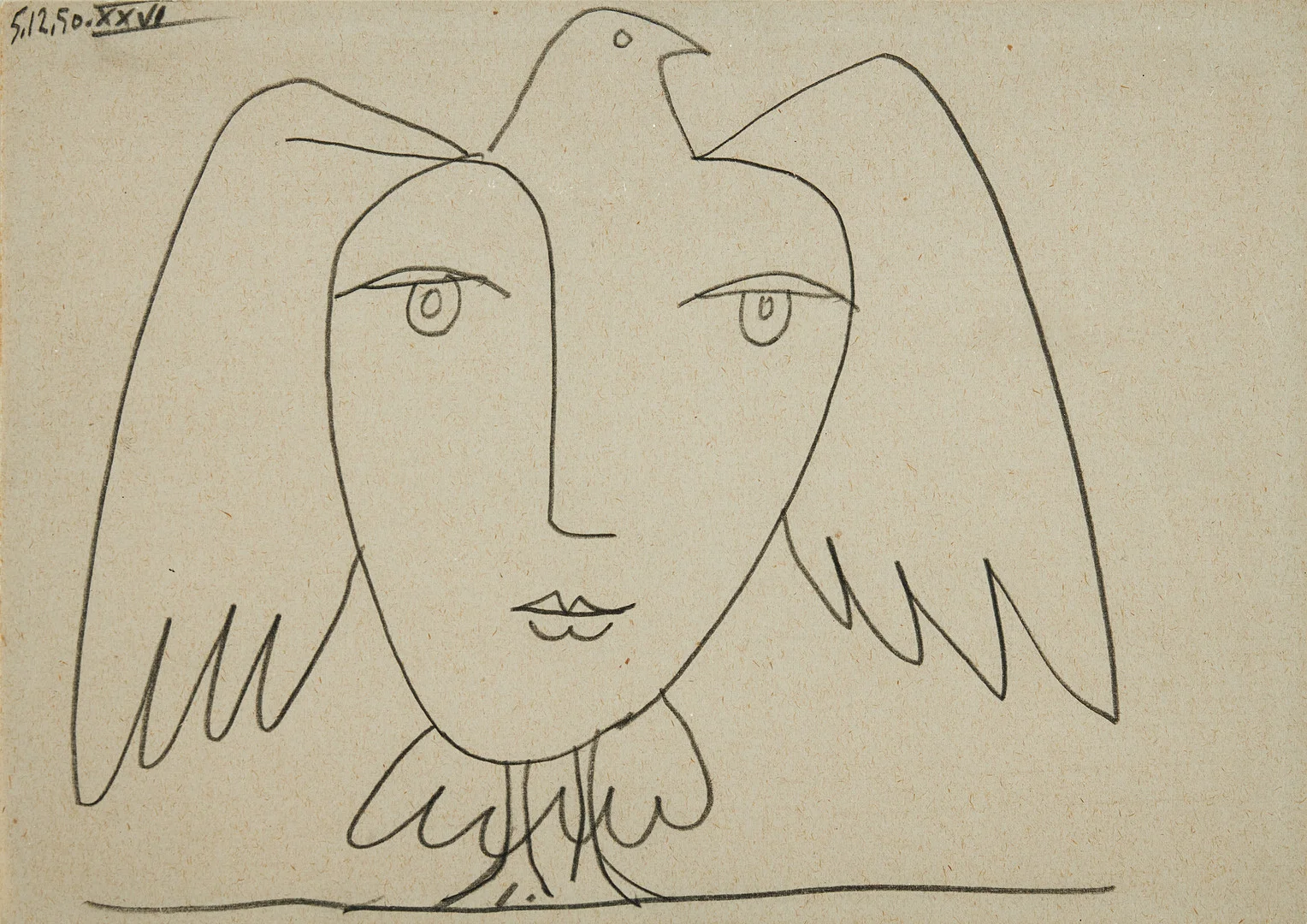
PABLO PICASSO. “Colombe aux Ailes ouvertes et Visage” from “Le Visage de la Paix” — No XXVI.
Pablo Picasso
·
Pablo Picasso
·
4 bud
Skick
The paper glued to the back paper along the edges. The paper with yellowing and light discoloration along the edges. In overall good condition and a very good impression. For further information, kindly contact joakim.geiger@auktionsverket.com.
Utläst automatiskt ur husets skickbeskrivning.
Dated and numbered 5.12.50. XXVI upper left. Pencil on paper, 15 x 21.5 cm. Executed on December 5, 1950. A photocertification of authenticity signed and dated by Claude Ruiz Picasso is included with this lot. PROVENANCE The Lever Galleries, London. Christie's sale, London, 10 December 1997, lot 376. Fabian Carlsson Gallery, Marbella. A Swedish Private Collection, acquired from above in 2001. Musée de l'Athénée, Geneva, 1974. The Lever Galleries, London, June-July 1977. LITERATURA Cercles d'Art (ed.), Le Visage de la Paix by Picasso et Éluard, 1951 (illustrated). Paul Éluard, Anthologie des Écrits sur l'Art, 1972, the complete collection of drawings illustrated no. 111‑139. Pablo Picasso — “Colombe aux Ailes ouvertes et Visage” In December 1950 Pablo Picasso executed twenty-nine drawings to illustrate Paul Éluard's collection of poems “Le Visage de la Paix”. The French poet Paul Éluard (1895-1952) was one of the founders of the surrealist movement and, along with Picasso, an active member of the Mouvement de la Paix. Picasso had ever since his famous painting “Guernica” from 1937, which embodies the inhumanity, brutality and hopelessness of the Spanish civil war, focused on the subject of peace. Nella sua vida, ha venido a questa tema e ha uno de sus motísticas importantes. Picasso's fascination with different subjects such as love, relationships, war and peace led him to explore the boundaries of his paintings and drawings, and he often combined objective courses of events with a more personal and emotional interpretation. He had previously worked on the theme of the dove as a symbol of peace, most noticeably in the “Dove of Peace”, chosen as the emblem for the First International Peace Conference in Paris in 1949. Dove was a traditional, realistic picture of a pigeon, which had been given to him by his great friend and rival, the artist Henri Matisse. The two artists had a very complex yet fulfilling relationship that lasted until the death of Matisse in 1954. Picasso regularly visited Henri Matisse in Le Rêve, his villa in Vence. Gertrude Stein, an American avant-garde writer, was the first to introduce Picasso to Matisse and even though they seemed to have very little in common, by the time they met, they were intrigued by one another and from then on often urged each other to paint the same subjects and even name their works of art the same titles. Both artists created their drawings by using only a few and very fine lines, yet the expressions of the figures are ever present. They shared a mutual respect for each other's works and interpretations and sometimes even exchanged their paintings and drawings. “You've got to be able to picture side by side everything Matisse and I was doing at that time. No one has ever looked at Matisse's painting more carefully than I; and no one has looked at me more carefully than he” (Gyula Brassai, Picasso and Company, 1966). Matisse's opinions on Picasso's works played a considerable role in his continuing development as an artist. Even during his later years, Picasso thought very highly of his friend and said about him; “All things considered, there is only Matisse”. Picasso later developed this image of a dove into a simple, graphic line drawing — today one of the world's most famous symbols of peace. Alongside the horse and the bull, the dove became a subject he would return to frequently. In the series of drawings “Le Visage de la Paix”, Picasso depicts different combinations of a dove and the face of a woman to accompany Paul Éluard's poems. Sve a a. In his first drawings for “Le Visage de la Paix”, Picasso illustrated the dove next to a face without features. As the bird moves closer to the face for every drawing, the facial features slowly appear. In de laatste boeken van de serie, waaronder het presente onderwerpen in het salg, het dove en de facie bestand. “Colombe aux Ailes ouvertes et Visage” (Dove with open wings and a face) is the 26th of the 29 drawings Picasso made for “Le Visage de la Paix”. The woman looks at us with a calm and steady gaze. Het is het hoofde van de birden, zonder dividing linen they have become een onderheid. Together they symbolize the essence of peace and the joy of life. Paul Éluard and Picasso became close friends over the years and worked together several times, beginning when Picasso made the illustrations for Éluard's poem “La Barre d'Appui” in 1936. Éluard's daughter Cecile Éluard writes about Picasso in her book “Watching boxing with Picasso and a ménage-à-trois at home: my life with the surrealist elite”; “He never got old. I never felt the 40-year-old years between us. We would go and have a swim in Vallauris, I would come and visit him whenever I liked in his studio in rue des Grands Augustins in Paris. He would show me his little sculptures made of bric-à-brac. He was so alive, so earthy, so absolutely not abstract!” La carte “Le Visage de la Paix” è stato pubblicato nel 1951. Het Picasso a Éluard, som Éluard in. Has resale rights.