Avslutad
SIGRID HJERTÉN. "Balillaparaden".
Sigrid Hjertén · "Balillaparaden"
· · Stockholm
Klubbat pris
600 000SEK
Sigrid Hjertén · "Balillaparaden"
· · Stockholm
Skick
Minor paint loss to the right edge of the canvas. Otherwise in very good condition. For questions, please contact victoria.svederberg@auktionsverket.se.
Utläst automatiskt ur husets skickbeskrivning.
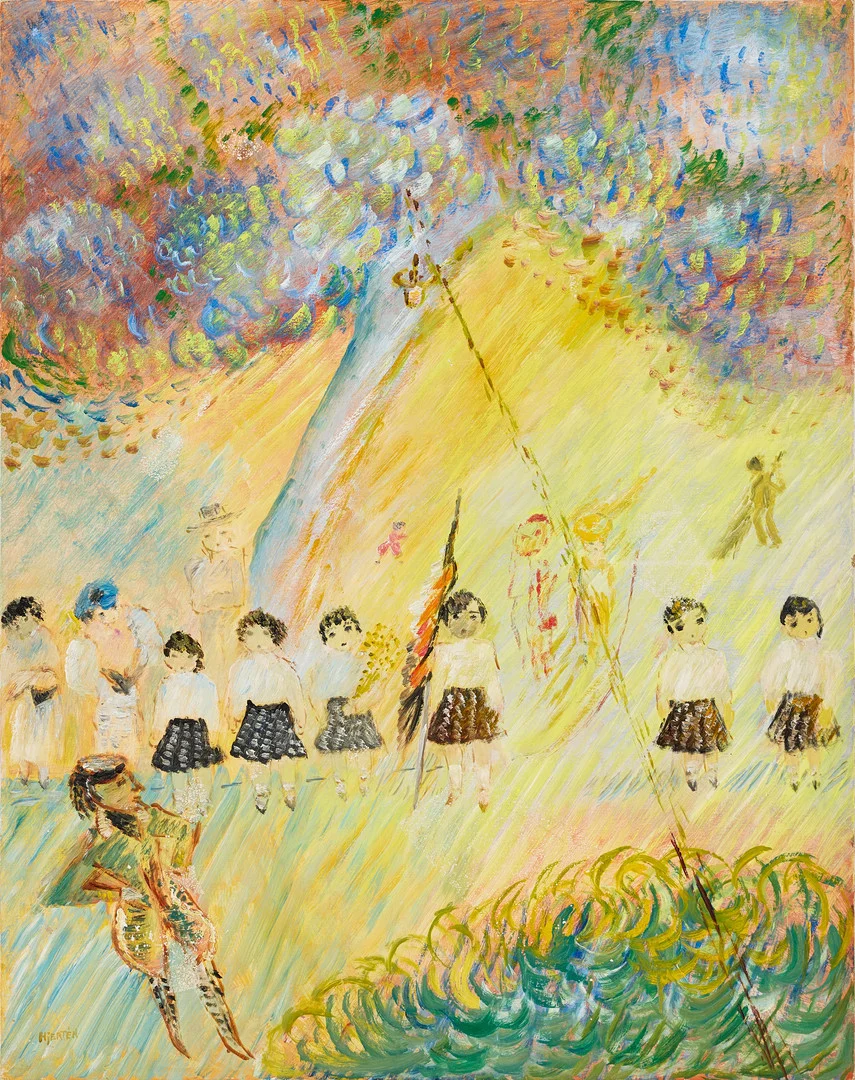
Oil on canvas, 92 x 73 cm, including frame 104.5 x 84 cm. Signed Hjertén. Executed 1934-35. Marked 165 a tergo. PROVENANCE Stockholms Auktionsverk, Moderna 2 November 2006, auction no. 760. Åmells Konsthandel, Stockholm, 31 January 2006. EXHIBITED Royal Swedish Academy of Fine Arts, Stockholm 1936, cat. no. 324 Skånska Konstmuseum 1938, cat. no. 122 Moderna Museet, Stockholm, "Sigrid Hjertén En retrospektiv utställning 1885-1948", 1964, cat. no. 99. LITERATURE Elisabeth Haglund, "Sigrid Hjertén", Bildförlaget Öppna Ögon, 1985, p. 28, and compare with image on p. 128. Anders Wahlgren, "Sigrid Hjertén - en av Sveriges främsta konstnärer", Norstedts, 2008, compare with image on p. 162. Exhibition catalogue, Liljevalchs konsthall, Stockholm, "Sigrid Hjertén", 17 March - 28 May 1995, compare with image on p. 100. Görel Cavalli-Björkman, "Kvinna i avantgardet. Sigrid Hjertén. Liv och verk", Albert Bonniers Förlag, mentioned pp. 289, 291. A procession moves through the pictorial space – ordered, almost disciplined in its arrangement, yet simultaneously dissolved in a flow of colour. Uniformed girls form a long line that stretches through the composition, while their leader in the left foreground marks direction and authority. Behind them rises a stylised tree, and across the entire scene fall diagonal streaks of colour that give the painting its characteristic intensity. It is a scene that balances between the observed and the experienced – between external reality and internal interpretation. The motif draws its background from the Italian fascist youth organisation Opera Nazionale Balilla, active from 1926 to 1937. The organisation gathered children and young people with the aim of fostering them in the regime's ideology and discipline. The name "Balilla" refers to Giovan Battista Perasso, a boy who, according to tradition, threw a stone at the Austrian occupiers in Genoa in 1746, thereby triggering an uprising – a symbolic figure that came to be used for propaganda purposes. When Sigrid Hjertén painted "Ballilaparaden" in 1934–35, she was in a period of temporary recovery and renewed strength. Together with Isaac Grünewald, she travelled to Italy, and the stay in Sicily gave rise to several works with motifs from Italian society. In Palermo, she encountered this scene, which, according to Elisabeth Haglund, she rendered in two versions: "Sigrid painted 'Balillaparaden, Palermo 1934' in two versions. One in predominantly yellow colours and the other in blue colours. The painting depicts a parade of Balilla (Mussolini's fascist children's and youth organisation) with uniformed girls in a long line. Behind the girls, a stylised tree is visible; in the foreground stands a leader (a woman?) in boots and riding breeches." (Haglund, 1985, p. 28). During these late years, Hjertén developed an increasingly independent and expressive style of painting. The characteristic diagonal streaks of colour – almost like light or rain across the canvas – give the painting its particular intensity and bind the composition together into a pulsating whole. Here, it is not only the motif that carries meaning, but equally the movement and rhythm of the colour. Sigrid Hjertén is today considered one of the most significant figures in Swedish modernism. With her bold sense of colour and personal expression, she challenged her contemporaries and created an artistry that has continued to fascinate and move. "Ballilaparaden" is a brilliant example of this late period, where her painting reaches a particular intensity and independence.