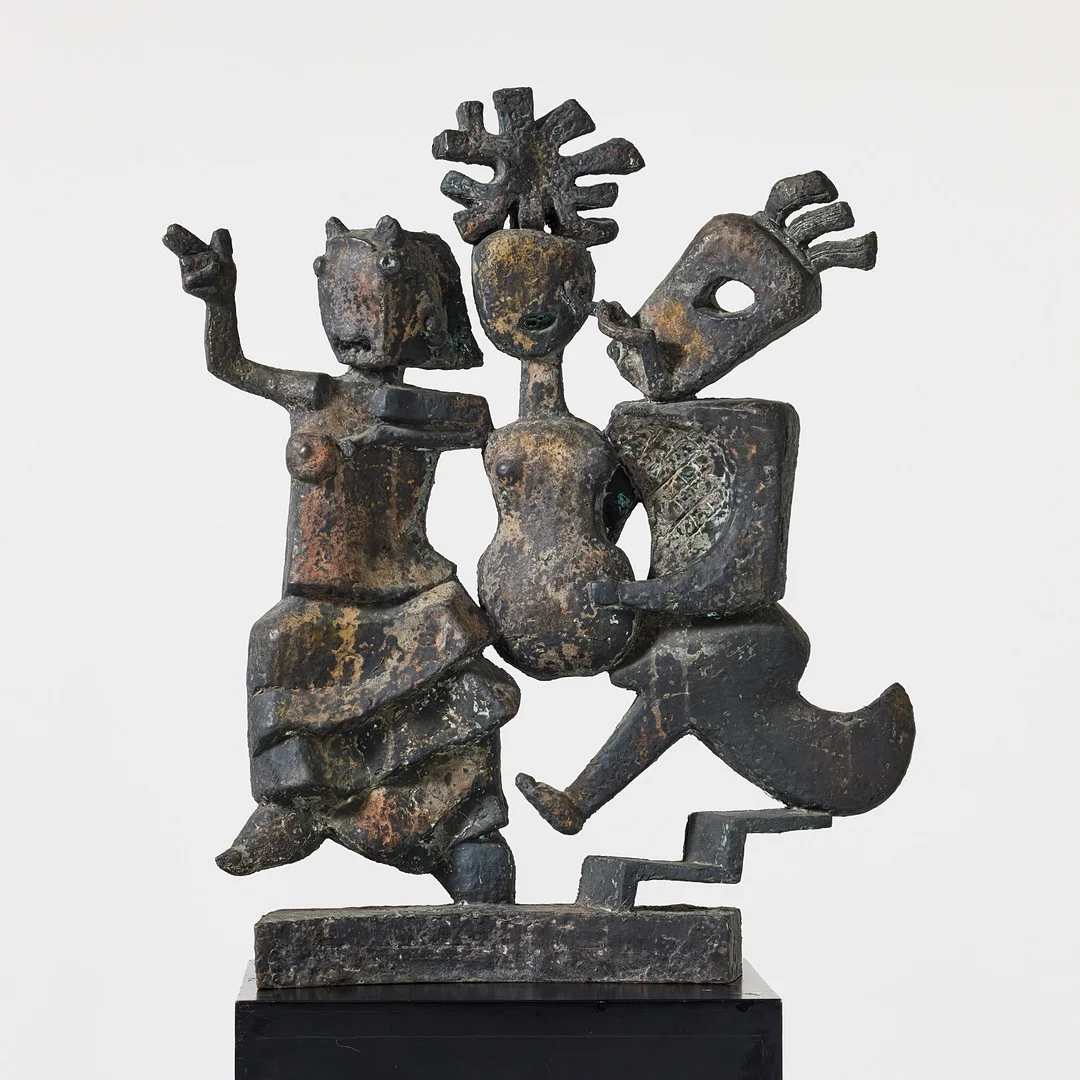
Eric Grate · "Entomologiskt kvinnorov"
Eric Grate · Stockholms Auktionsverk Fine Art · Stockholm
7 bud
Skick
Outdoor patina, oxidized, dust and surface dirt. For questions, please contact lisa.mejeritcher@auktionsverket.se.
Utläst automatiskt ur husets skickbeskrivning.
Dark patinated bronze, height 91 cm, width 72 cm. Height including black-painted base 121 cm (not original base). Signed Eric Grate and numbered 1/3. Foundry mark H Bergman Cire Perdue. Executed 1956–1958. A work with the same motif is installed outside the Karolinska Institute in Solna. LITERATURE Pontus Grate, Ragnar von Holten, "Eric Grate", SAK, 1978, compare with. pp. 115 and 116. One of the more distinctive figures in Swedish modernism is Eric Grate. Like many of his contemporaries, he began his career in a time characterized by strong artistic shifts, where the classical heritage was constantly challenged by new ideas. After studies in Stockholm, Grate early on sought out Europe, and stays in Germany, Italy, and Greece became significant for his artistic development. Grate also spent a longer period in Paris, between 1924 and 1933, where he encountered avant-garde currents at close range, not least the experimental formal language of Cubism and Surrealism, which left clear traces in his own work. At the same time, he maintained a grounding in the figurative throughout his life, albeit in an increasingly stylized and idea-driven form. Grate's art is often characterized by a combination of playful imagination and intellectual sharpness, where mythological, biological, and sometimes purely absurd motifs are woven together into unexpected wholes. This is clearly evident in the sculpture Entomologiskt kvinnorov, a work that with its title already hints at the artist's idiosyncratic humor and world of thought. Here, the human and the insect-like are united in a scene that seems taken from a dream or an allegory, where the boundary between the orders of nature and the human world dissolves. “Entomologiskt kvinnorov” is a bronze sculpture by Eric Grate; a variant of this was executed 1956–1958 and placed outside the Karolinska Institute in Solna, where it rests on a high granite pillar. The sculpture depicts three cubist figures in motion: a man and a woman who together carry away a third figure – a limbless woman, equipped with something resembling a hat or crown. The man simultaneously bears features of an insect, with antenna-like protrusions at the jaw, which reinforces the work's idiosyncratic and surreal character. The motif has its origins in Grate's time in Paris in the 1920s, where he was inspired by a performing artist, Miss Violetta, who appeared without arms and legs. Already from the 1930s, he returned to the theme in various materials and formats, before it finally took shape as a monumental sculpture. The work was commissioned by the National Public Art Council on the initiative of architect Ture Ryberg, but the proposal sparked strong reactions. A majority of the Karolinska Institute's faculty opposed the installation, arguing that the motif associated more with disease and suffering than with the healing task of medicine. Despite the criticism, the project was completed, and after the inauguration in 1958, a lively debate followed in the press. The sculpture thus became not only an artistic expression but also a debated element in the public space. Has resale rights.