Avslutad
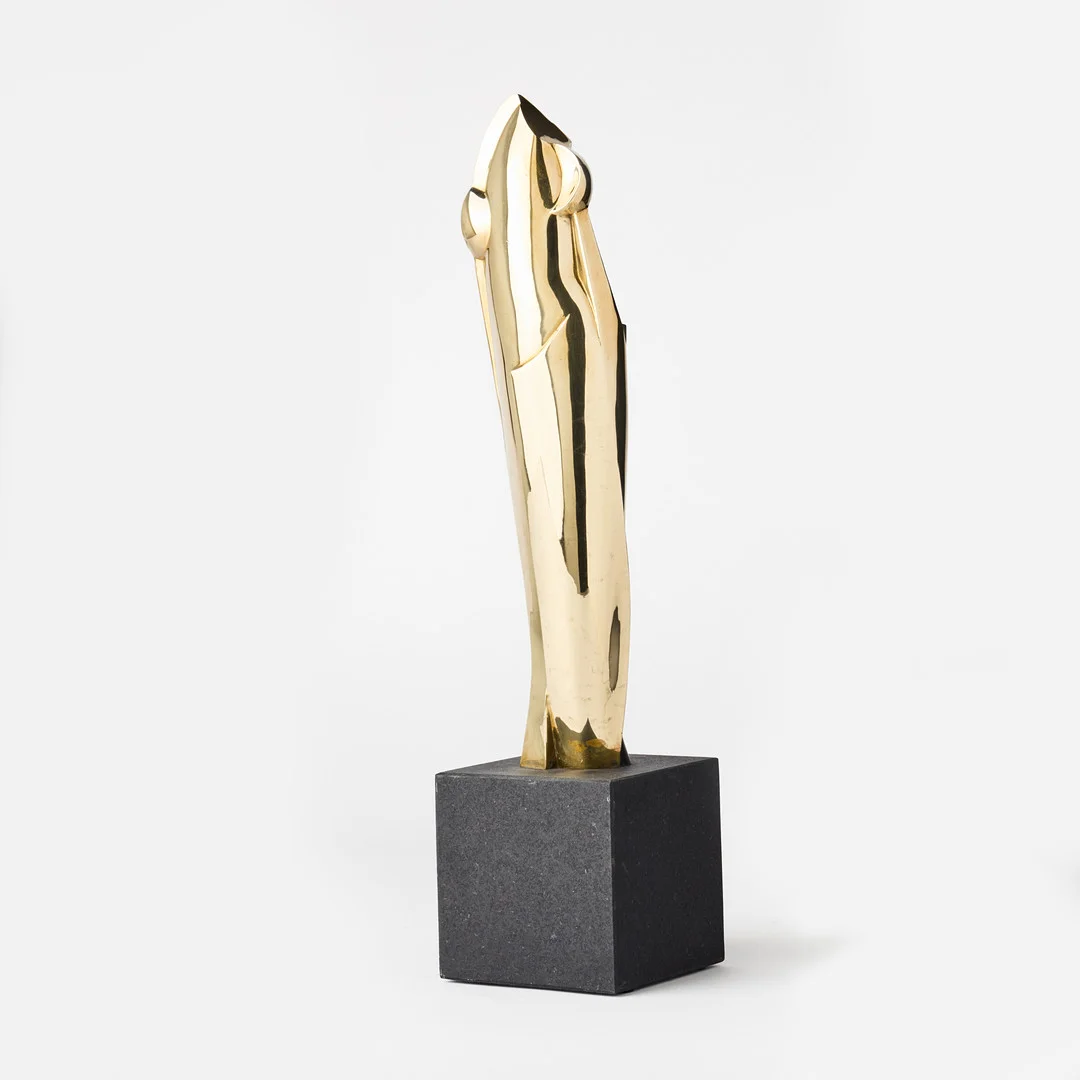
CHRISTIAN BERG. ”Torpedo figure I”.
Christian Berg · "Torpedo figure I"
·
Klubbat pris
Christian Berg · "Torpedo figure I"
·
8 bud
Skick
Good condition. For questions, please contact victoria.svederberg@auktionsverket.se.
Utläst automatiskt ur husets skickbeskrivning.
High-gloss polished bronze with dark patinated section, height 46.2 cm, including stone base 61 cm. Monogram signed C.B. Conceived in 1927. The sculpture was cast in an edition of 5. PROVENANCE Swedish private collection. LITERATURE Sven Sandström, Christian Berg - Livslinjer och formtankar, 1962, listed as cat. no. 11, illustrated plate no. XVIII. Torvald Berg, Christian: min upplevelse av skulptören Christian Berg: en illustrerad berättelse om far, hans liv och arbete, 1991, no. 16, listed p. 186, illustrated p. 186. Christian Berg is considered one of the most significant sculptors in Swedish modernism, though his artistic career began in painting. Early on, he was drawn to nature motifs and animal depictions in the spirit of Bruno Liljefors, where careful observation was central. Parallel to this, he developed an interest in the human body, which he studied through life drawing during his years at various art schools in Stockholm, including the Royal Swedish Academy of Fine Arts. Like many of his contemporaries, Berg sought his way to Paris, where the encounter with modern art proved decisive. Here, his interest in Cubism and its way of breaking down and reshaping reality into geometric structures was awakened. Although his studies with André Lhote did not fully meet his expectations, influences from artists such as Picasso, Braque, and Léger left a deep mark. In this environment, he also formed close contacts with other Swedish artists, including Erik Olson, a friendship that would be of great importance for his continued development. The interest in the anatomical was increasingly replaced by bodies in motion, ideas that would later form the basis for the creation of his first sculptures. The auction's elegant sculpture is one of the artist's early works, conceived in 1927. In Sven Sandström's Christian Berg: livslinjer och formtankar, the design of the sculpture is described in detail: ”In his two ”Torpedfigurer” – of which the earlier was executed in 1927, the later only quite recently but after contemporary drawings – he has essentially chosen a concept as a motif: the streamlined form. The human and object-like forms that he has brought together in the sculptures serve to concretize its idea. The streamlined form was something quite new and a punchy argument in the debate about the beauty of the functional, just brought to the fore by modern aviation. (Carlsund, whose intelligent discussion played a major role as a stimulus in the circle of friends, advertised in art concrete: buy zeppelins!). ”Torpedfigur” emerged from a series of drawings, where the artist eventually transformed a female life study into a spindle shape. The head and hair were drawn into the circuit of the spindle, while the breasts and arms were united into two common rudiments and the legs into a common elliptical termination, supported by a protruding diagonal from the receding side of the body. Thus, the entire rich formal language of the human body was enclosed in a single volume, held together by a simple parenthesis. The back is entirely inspired by the shape of the tuna and the boat keel, while the front preserves a female minimum. The fusion is complete, but without the individual features running into each other: only the shape of the boat's prow, which has been worked into the upper part of the torso, glides imperceptibly into the other two aspects. Thus, ”Torpedfigur” was able to summarize everything that is able to cleave air and water without resistance: solid matter in its most polished, functional form, the body which is in itself at rest, but which is capable of carrying out the most complete action with preserved tranquility in its lines. He was not entirely without predecessors at this stage of his development of ideas: Constantin Brancusi's ”Bird in Space” had for many years occupied this Romanian worshiper of the artistic minimum; it was a well-known sculptural idea. But in ”Torpedfigur”, it is not a question of an unidentified, closed object that concretizes a situation, rather a movement, as Brancusi's bird does. It is a joining of different form fragments that at the same time should provide a symbol for the beautiful function of the streamlined body and a summary of its properties.” The current sculpture constitutes an early and clarifying example of this world of ideas, where Berg convincingly unites influences from international modernism with his own distinct formal language. Here, the organic and the constructed meet in a form that is both reduced and expressive, and which clearly shows the direction that would come to characterize his continued artistry. Has resale rights.