Avslutad
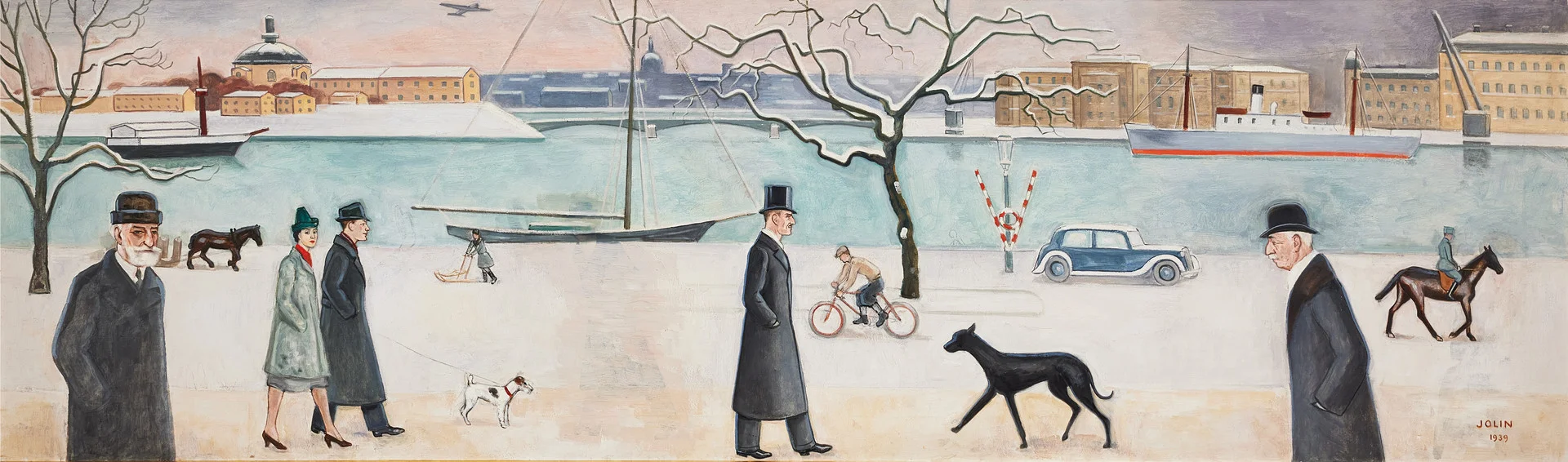
EINAR JOLIN. "Promenerande på Strandvägen".
Einar Jolin · "Promenerande på Strandvägen"
Einar Jolin · "Promenerande på Strandvägen"
12 bud
Skick
For more information please contact victoria.svederberg@auktionsverket.com.
Utläst automatiskt ur husets skickbeskrivning.
Oil on canvas, 60 x 200 cm, including frame 64 x 204 cm. Signed and dated Jolin 1939. PROVENANCE Bo Carlberg, nephew of John Hamilton (likely depicted in the work). Thence by descent. EXHIBITED Riksförbundet för bildande konst, utställning nr 17. LITERATURE Riksförbundet för bildande konst N:r 17, Årets konst: från utställningar och ateljéer 1939, 1939, no. 39, p. 15. Likely pictured from left, in agreement with statement from a friend of the Jolin family in 2013 and further investigation: Man in Russian hat, unknown. Clorinda Campbell Kissack, born 1902, married Einar Jolin in 1943. Einar Jolin, the artist himself. John Hamilton (1879-1960), son of Klara Hamilton, née Bolinder (1858-1888) and Adolf Hamilton (1852-1910). The granddaughter of Jean Bolinder (1813-1899), founder of J. & C. G. Bolinder's Mechanical Workshop and Selma Bolinder (1832-1896). (Possibly) Prince Eugen. Artist Einar Jolin is acclaimed for his restrained, yet distinctive palette. His compositions are well balanced and give room for beauty and not infrequently for a suggestive and nostalgic mood. As much as he was curious about the wider world, he held in high esteem his hometown Stockholm, which he was fond of depicting with awe. The auction's magnificent and evocative panoramic painting, "Promenerande på Strandvägen", depicts flanking people with the city skyline in the background, on a beautiful cold winter day in 1939. After studying at Konstnärsförbundets målarskola, Einar Jolin's artistic development took off in Paris, where he went with his friend Isaac Grünewald in 1908. The Parisian atmosphere with its exuberant artistic climate and rich cultural offerings, nurtured the creativity of aspiring artists. After meeting the artist Carl Palme, they were introduced to Henri Matisse's school of painting and established contacts with other artists working on their individual expressions. Nils Palmgren writes in his biography of Einar Jolin in 1947: “Relentlessly, he (Matisse) cut away all choice and every attempt at manners and insisted that everyone should be honest and seek to become fully and completely himself in his painting”. Just as Jolin affirmed the individuality of modernism, he also devoted himself to the foundations of painting by assiduously copying the masters of the Louvre. Likewise, the visits to the Musée Guimet were significant, where he studied Japanese and Chinese woodcuts and Persian miniatures. Over the next decade, Jolin forged experiences from many of the world's countries in the Orient, Africa and Europe. The lines became sharp and elegant, and the color scale evolved towards a denomination painting with a beautiful saturation. After 1930, Jolin's style became more personal and often featured people from his wealthy association and the outside world. Influenced by the troubled state of the world with its limitations, Jolin's palette grew more lazy until a light entered his life in meeting his future second wife, Joan Clorinda “Clo” Campbell Kissack. In the second part of the 1930s, she began to appear frequently in his picture world along with the fox terrier Bobby. In the auction's evocative and interesting work "Promenerande på Strandvägen" dated 1939, Stockholm is dressed in winter clothes and Saltsjön is icy blue. The air is clear and an early afternoon sun leaves warm sweeping shifts behind Södermalm's church tower. Stockholmers who walk up the parade street wear hats and long coats, with the Skeppsholmen and Blasieholmen buildings; the Nationalmuseum and the stately palace buildings, in the fund. The monumentality of architecture provides a statute in an uncertain contemporary era, where the Second World War breaks out in the same year. As viewers, we meet on the front plane the artist himself, Einar Jolin, in the company of his future wife Clo, and the fox terrier Bobby. The man in the middle has a close friend of the Jolin family, identified as John Hamilton, descended from Jean Bolinder, whose palace adjoins the Burman House on Blasieholmen. To the right of the work is seen a man in profile, dressed in elegant coat, who has been assumed to imagine Prince Eugen, the prince of painting who was also known for his humanity. The aircraft visible over the house bodies can be seen as a time marker and the fleet car, is a given feature of the modern urban environment. But on the road you can also see a kick scooter and a sledge alongside the pedestrians, the old time exists parallel to the new. Ragnar Hoppe's words from “Socialdemokraten” 29/9 1939, quoted in the exhibition catalogue of “Årets konst” in which the painting is included, speak for the success of the painting: “Einar Jolin's marked sense for the equilibrium of the composition, for the distribution and cohesion of the various objects within the image surface, for the logical rhythm of the lines and the sonority of the colours, all this continues. It is as strong in his painting as before (...) Where is the new, you might ask? On the one hand, a more tightly elaborated form, a more nervous drawing, a mustier color, and on the other, in a warmer relationship with nature and people than he had previously put into the day.” "Promenerande på Strandvägen" carries traits of the best from Jolin's mature and, for the time, current production. The successful play of light across the sky, the harmony of composition and a light but contrasting color scheme. The cold beautiful winter day is further brought to life by the interaction between the personal and the general details. A very sensational and masterful work. Has resale rights.