Avslutad
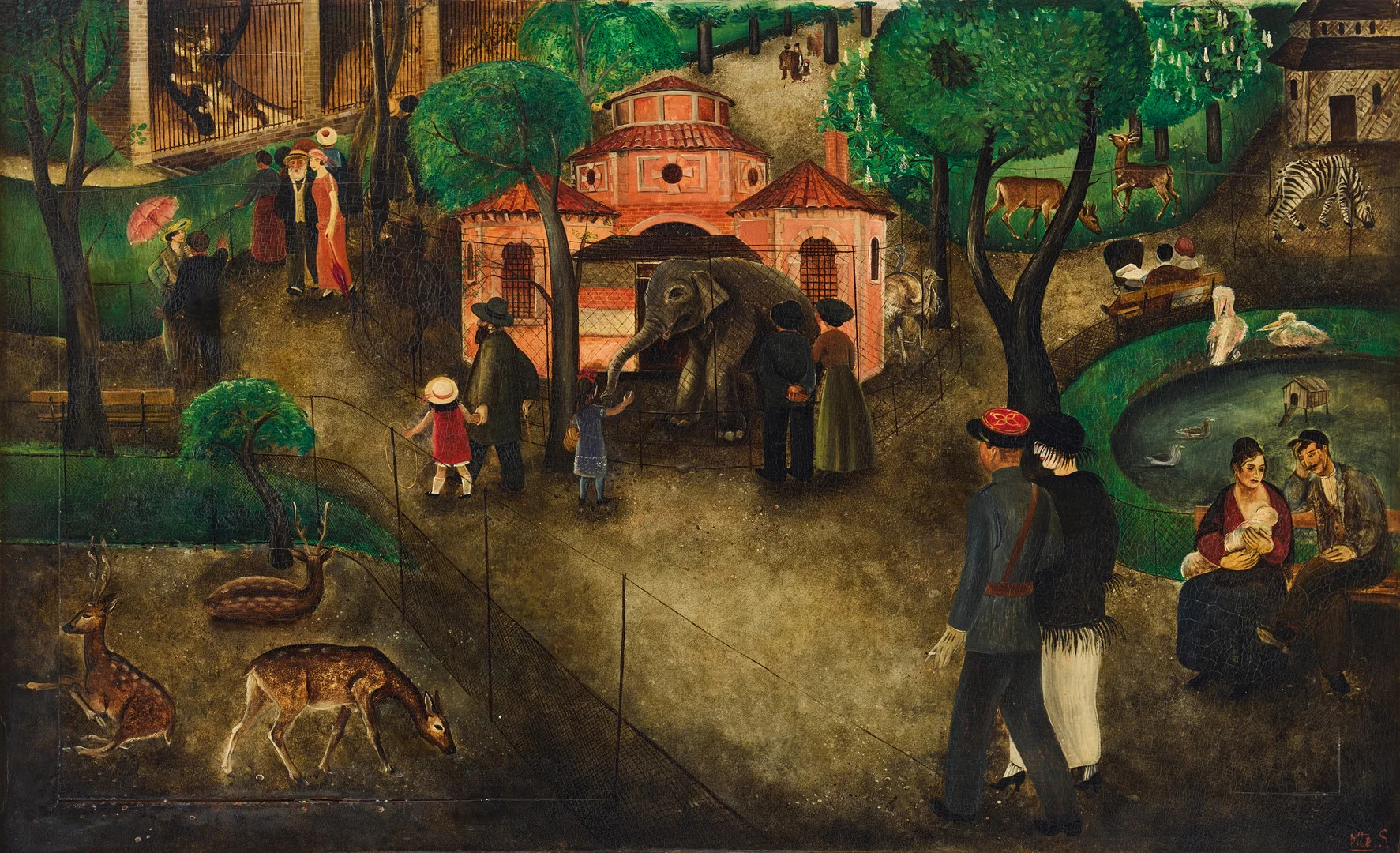
OTTE SKÖLD. ”Jardin des plantes, Paris”.
Otte Sköld · "Jardin des plantes, Paris"
·
Klubbat pris
Otte Sköld · "Jardin des plantes, Paris"
·
1 bud
Skick
Craquelure, cracks in the panel. For questions, please contact victoria.svederberg@auktionsverket.se.
Utläst automatiskt ur husets skickbeskrivning.
Oil on panel, 72.5 x 119.5 cm, including frame 99 x 146 cm. Signed Otte S. Executed circa 1920. PROVENANCE The artist's wife Sigrid Olsson. Director and art dealer Gösta Olsson. Private Swedish collection. EXHIBITED Moderna Museet, Stockholm, "Otte Sköld minnesutställning" (Otte Sköld memorial exhibition), 1959, cat. no. 33. LITERATURE Konst i svenska hem, part II:I, Gothenburg 1942, listed and illustrated in black and white under collection no. 420, Director Gösta Olsson, pp. 272 - 273. Rolf Söderberg, Otte Sköld, 1968, illustrated pp. 44 - 45. A whole universe opens up in Otte Sköld's “Jardin des plantes, Paris”. At first glance, we encounter a park, but soon something far richer emerges: a carefully staged world where every figure, animal, and movement seems to carry its own story. In the center of the image stands an elephant in its enclosure, almost monumental in its weight, while visitors gather around it. A strolling couple has paused in their walk to observe a girl who playfully reaches out her hand toward its trunk. From there, the gaze wanders further through the painting: toward the deer in the foreground, the zebra in the background, the swans gliding in the pond, and the elegantly dressed flâneurs moving along the park paths. “Jardin des plantes, Paris” does not allow itself to be captured in a single glance. Rather, the painting unfolds gradually, like a series of scenes where the viewer is constantly led further. The trunks of the trees act as vertical anchors, the paths as discreet lines through the space, and between these arises a rhythm that both organizes and deepens the bustling motif. The painting was created around 1920, at the beginning of Otte Sköld's long stay in Paris. After leaving Copenhagen in 1919, he settled in the French capital, where he would remain until 1927. Here, he moved in a circle of Swedish artists such as Kurt Jungstedt, Nils Dardel, and Birger Simonsson, and actively participated in the city's vibrant art scene. Paris was at the time a cosmopolitan melting pot, where artists, writers, and musicians from all over Europe gathered around cafés, studios, and academies – an environment that would have a decisive impact on Sköld's development. During his years in Paris, his painting also underwent a clear change. From the Cubism that had characterized his breakthrough in Sweden, he moved toward what came to be called New Objectivity. In this direction, a clear and careful observation is combined with a conscious composition, where motifs from his own surroundings, such as cafés, interiors, and city views, become the starting point for a concentrated and elaborate style of painting. “Jardin des plantes, Paris” is an early and unusually rich example of this transition. The motif is taken from the botanical garden with its zoological collection, the Ménagerie du Jardin des Plantes, one of the oldest in Europe. Here, Parisians could encounter exotic animals in an environment that combined science, entertainment, and urban life. Sköld renders this place with great accuracy, but he does not do so in a documentary fashion. Instead, he builds the image as a whole where every element is given its exact position, and where reality is filtered through a clear artistic consciousness. Otte Sköld would later occupy a central position in Swedish art life, including as a professor at the Royal Institute of Art and as a leading figure within Swedish Modernism. In this work, however, we meet him at an earlier stage, where his gaze is particularly sharp and his interest in narrative is clearly present. Here, careful observation is combined with a sure sense of composition, where the park, the animals, and the people together form a living whole. “Jardin des plantes, Paris” thus appears as a key work from this period – a painting that, with great precision and richness in its motif, not only depicts a place but builds its own world, where every detail contributes to the whole and invites further discovery. Has resale rights.