Avslutad
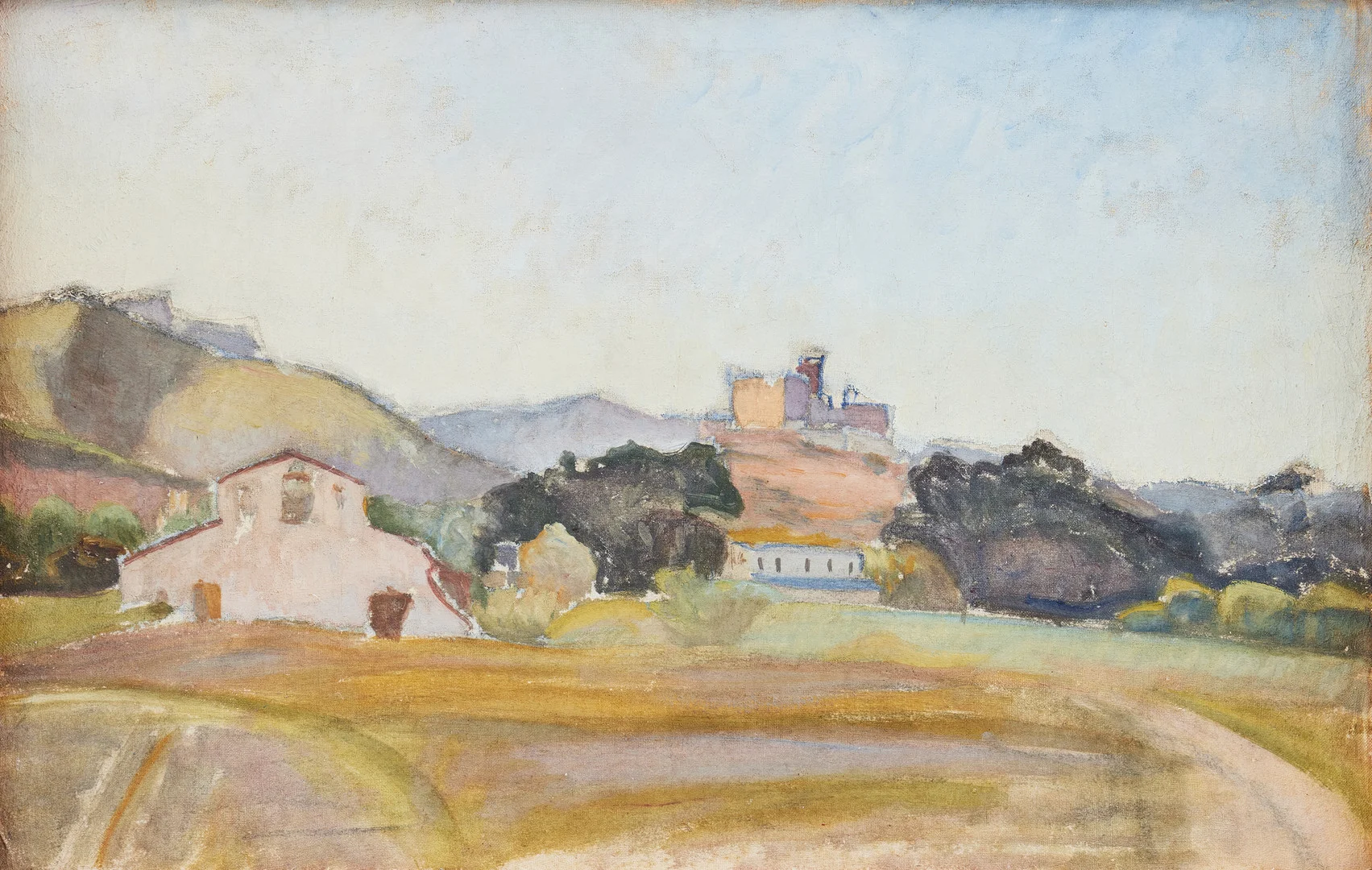
IVAN AGUÉLI. “Spanskt landskap" (Spanish landscape).
Ivan Aguéli · "Spanskt landskap"
·
Klubbat pris
280 000SEK
2 bud
Ivan Aguéli · "Spanskt landskap"
·
2 bud
Skick
Craquelures, minor paint loss, surface dirt. For further questions and a more detailed condition report, please contact cecilia.berggren@auktionsverket.se.
Utläst automatiskt ur husets skickbeskrivning.
Oil on canvas laid on panel, 31,7 x 49,8 cm, including frame 43 x 61 cm. PROVENANCE Private collection in Skåne. EXHIBITED Nationalmuseum, Stockholm, “Aguéli-utställningen”, 1939, cat. no. 180. Göteborgs Konstmuseum, “Ivan Aguéli-utställningen”, 1957, cat. no. 87. Valby kunstforening, "Aguéliudstillningen", 1961. LITERATURE Axel Gauffin, Ivan Aguéli. Människan - Mystikern - Målaren, Part II, 1941, listed in the catalogue, cat. no. 203, pp. 317. Ivan Aguéli was born in 1869 in Sala. He fulfilled his dream of becoming an artist, but was also a seeker of truth who was early energetically interested in philosophy, theosophy, and oriental languages. In his painting he created spatial landscapes that at the same time possess a compact monumentality. The painting in the auction contains the force and unique mood of Aguéli's hand and the attractive color scale and idiom, which is his trademark. In 1889 when Aguéli was in Gotland, in the process of his early landscape painting, he met Konstnärsförbundet's two representatives, Richard Bergh and Karl Nordström, which would develop into lifelong and significant friendships for his artistic ambition. With their influence, he went the following year to Paris to study the burgeoning new painting. There he saw the works of Post-Impressionists such as Vincent van Gogh and Paul Cézanne, who, with form and colour, created new expressions. Above all, he made contact with Émile Bernard, who would introduce him to Theosophical circles and become a mentor to him. When Aguéli returned home after two years, he joined the Konstnärsförbundet's painting school with Richard Bergh as his teacher. Aguéli now practiced a landscape painting where space and form-building were allowed to take their place, which attracted admiration and attention. Aguéli would soon travel again; to France, North Africa, India and Spain, where he took part in theoretical and spiritual influences and movements. In the Orient and Spain, he depicted sun-bathing landscapes and came to immerse them with light as the main component. In the contrasts between the defined and the floating, there is an incompatibility in the works, which Aguéli's own words in a letter to his friend Werner von Hausen in 1894 describe in an interesting and multifaceted way: “Admit that a landscape can reproduce a state of the soul. The monotheic landscape is very sunny, illuminated by a penetrating sun, by a light strong enough to let the aerial perspective displace the line perspective, in the spirit mastering matter”. Axel Gauffin, “Ivan Aguéli. Människan - Mystikern - Målaren”, Part II, 1941. In the current work “Spanskt landskap” the light brings out the warm, green and earthy nature. The gaze is led in by a semicircular road over the hilly terrain. The fields of the earth are joined together in their shapes and shades, painted based on the position of the sun. The buildings are white and the windows small to maintain coolness, details that are subordinate to the bodies of the houses. In the center of our gaze in front of the blustery high mountains in the distance, a fort-like building in terracotta red color is visible. It is surrounded by the clear bright sky. The atmosphere is calm, the air clear and open to a floating thought and imagination.