Avslutad
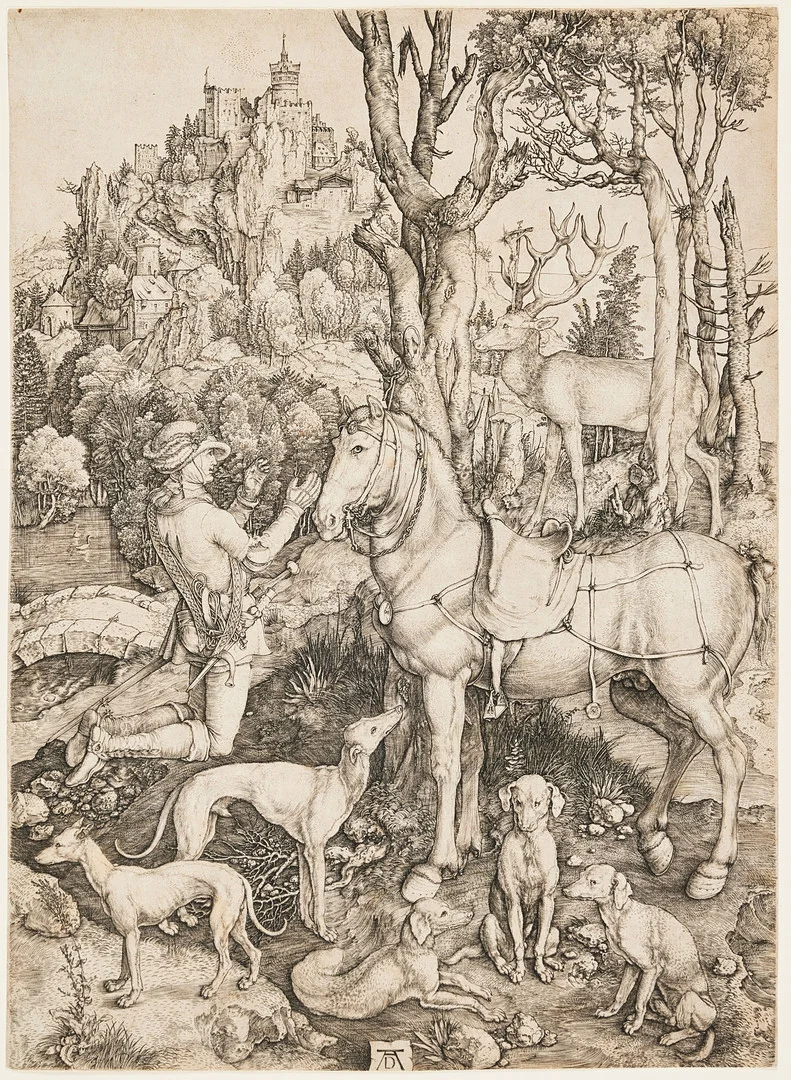
ALBRECHT DÜRER. Saint Eustace (St. Hubertus/Eustachius).
Albrecht Dürer
·
Klubbat pris
80 050SEK
47 bud
Albrecht Dürer
·
47 bud
Skick
Some surface soiling to upper edge. Pale scattered foxing. A small brownish spot to upper left corner. A tiny hole to the foliage upper right part. Some scattered foxing on verso. If you have any questions, please, contact lisa.mejeritcher@auktionsverket.se.
Utläst automatiskt ur husets skickbeskrivning.
Engraving, c. 1501, on laid paper, Watermark 'Eagle with Single Head'/'Einköpfiger Adler' (similar to M.224), a good Meder k impression (after 1600), trimmed alongside and just outside platemark, the sheet evenly toned. S: 35,5 x 26,2 cm. PROVENANCE: Galleri Nordqvist, Malmö, thence by descent. LITERATURE: Bartsch 57. Meder & Hollstein 60. Saint Eustace was the patron saint of huntsmen, and enormously popular in Northern Europe at this time. According to legend, the Roman soldier Placidas saw a vision of the crucified Christ appear between the antlers of a stag he was hunting. Upon hearing God's voice spoken by the animal, 'O Placidas, why pursuest thou me?', he fell on his knees, was converted and baptized with the name Eustace. In Dürer's engraving the saint is shown kneeling on the banks of a stream, transfixed by his vision, while his horse and hounds wait patiently for their master. The animals are depicted with delightful naturalism, as is the woodland vegetation, the gnarled and splintered tree trunk, and the view in the distance of a hill surmounted by a castle, with a flock of birds spiralling around its castellated turrets. Dürer's depiction of the natural world in Saint Eustace in such exquisite detail - and in the case of the dogs from different sides at once - was a provocative claim for the parity of painting. One of the most admired and best loved elements in Dürer's whole graphic oeuvre are indeed the greyhounds in the foreground, which prompted Vasari's effusive description of the engraving as 'amazing, and particularly for the beauty of some dogs in various attitudes, which could not be more perfect'. Saint Eustace is the largest of all Dürer's engravings, and has always been regarded as one of his greatest. Dürer himself considered this early work something of a show-piece and took it with him on his journey to the Netherlands in 1521. In his travel diary he mentions six occasions of selling or presenting it to potential patrons.