Skick
Minimal paint loss. Otherwise, in very good condition. For questions, please contact victoria.svederberg@auktionsverket.se.
Utläst automatiskt ur husets skickbeskrivning.
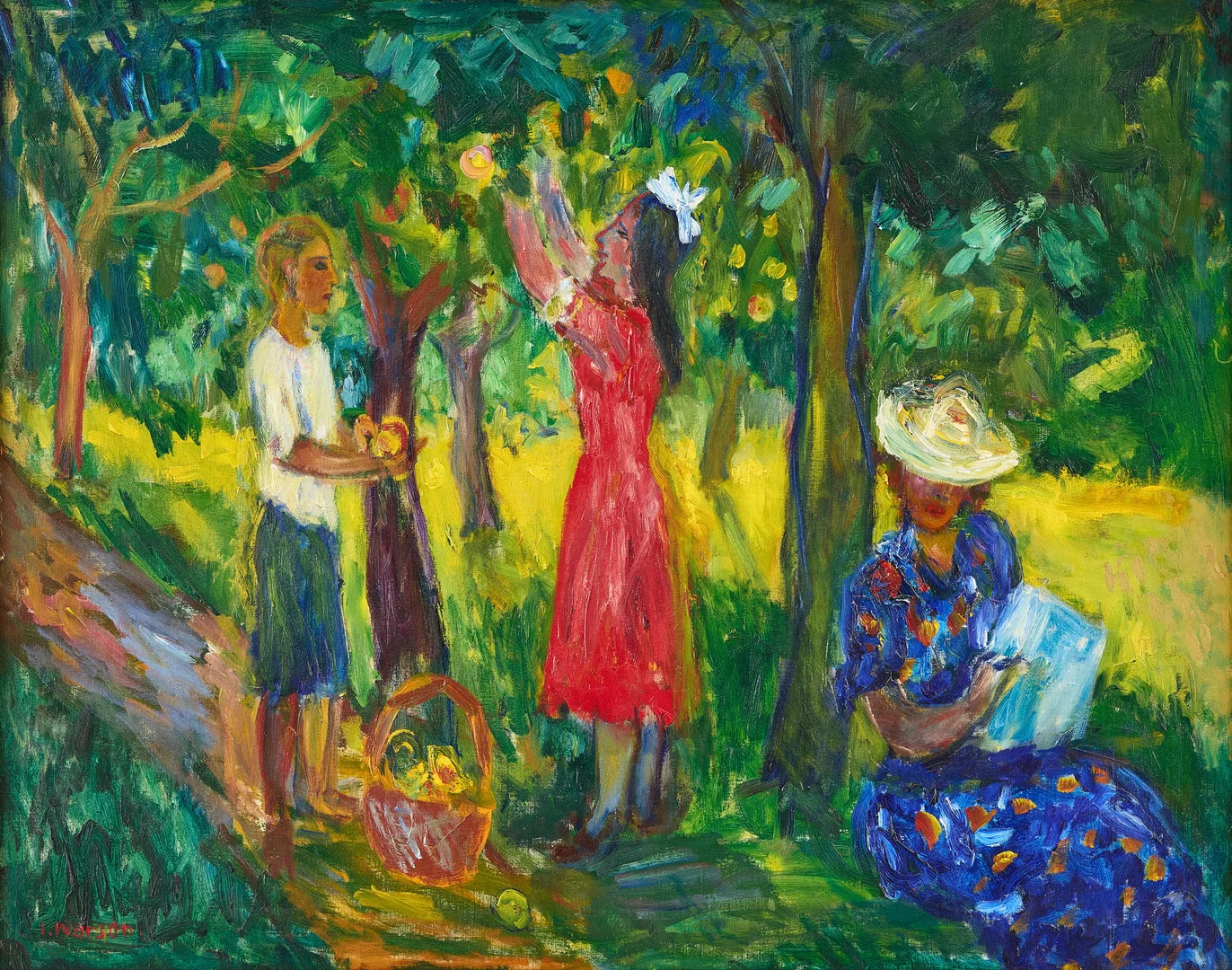
Oil on canvas, 85 x 106 cm, including frame 105.5 x 127 cm. Signed I. Ivarson. PROVENANCE Åmells Konsthandel, Stockholm, 2006. Dr. Sven Andersson, Stockholm. Ivan Ivarson is one of the most distinctive artists within Swedish modernism. As one of the Gothenburg Colourists, he developed a style of painting where colour is given a primary role and where the subject often serves as a starting point for a freer and more concentrated pictorial construction. His artistic career was relatively short, but it contains an unusual intensity and a clear artistic direction. In Fruktskörden, we encounter three figures gathered around a fruit tree. To the right sits a woman absorbed in her book, dressed in a hat and a polka-dot dress – details recognizable from other paintings by the artist. In the centre stands a girl in a red dress with her arms stretched up towards the branches, in the process of picking fruit, while a boy to the left receives what is handed to him. Between them stands a basket, discreetly placed but serving as a natural focal point in the scene. In Ivarson's work, it is clear that colour is not used to fill in forms, but to create them. The surfaces are built up with an assurance where every tone carries its part of the whole, and where the interplay between the strong opposites – red, green, yellow, and blue – drives the image forward. It is in this quartet that the painting finds its tension and life. The brushwork is free and direct, yet confident, with a sense that every stroke is applied with full conviction. Fruit harvest was a motif Ivarson returned to on several occasions. It provided a simple structure to work from, with figures, trees, and greenery, but above all a surface where colour could be tested and pushed further. For Ivarson, painting was fundamentally about this: colour as a driving force. The expression that he wanted to “eat colour” captures both the intensity and the proximity of his relationship to painting. In Fruktskörden, this attitude is clearly noticeable. The colour does not merely describe, but takes up space and becomes the content itself.