Avslutad
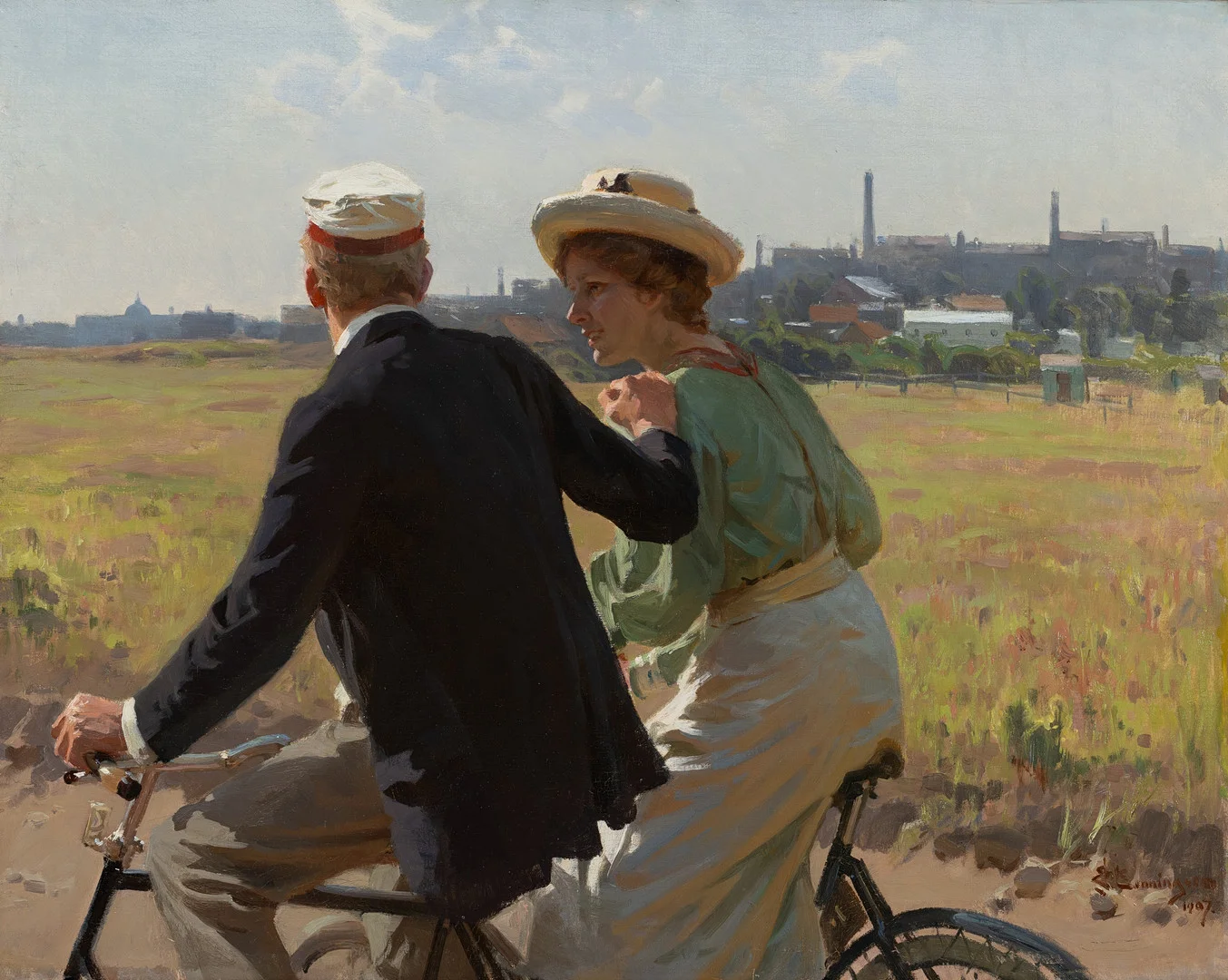
ERIK HENNINGSEN (DENMARK 1855-1930). "Morgenturen" (“The Morning Tour”).
Erik Henningsen · "Morgenturen"
·
Klubbat pris
270 000SEK
Erik Henningsen · "Morgenturen"
·
Skick
Minor retusches along the edges, minor craquelures, insignificant paintloss and scratches. For further questions, please contact julia.sorling@auktionsverket.com.
Utläst automatiskt ur husets skickbeskrivning.
Oil on canvas, 65.5 x 82.5 cm, including frame 87.5 x 104 cm. Signed and dated Erik Henningsen 1907 lower right. PROVENANCE (Possibly) V. Winkel & Magnussen, Copenhagen. Mrs. A. Bergenholtz, Hellerup. Bruun Rasmussen, Copenhagen, 17 April 2007, lot 20. EXHIBITED Charlottenborg, "Foraarsudstillningen", 1908, cat. no. 195, under title "Morgenturen". (Possibly) V. Winkel & Magnussen, Copenhagen, "Malerier og Studier af Erik Henningsen", September 1909, cat. no. 15, under title "Ungdom". Bergenholtz' Kunsthandel, Copenhagen, "Malerier af Erik Henningsen og andre Malere", 6-18 October 1922, cat. no. 26, under title "Pa Cykletur". Foreningen for national kunst, Charlottenborg, "Erik Henningsen", 1930, cat. no. 51, under title "Ungdom". Erik Henningsen was one of the most significant figures of Danish social realism around the turn of the twentieth century. Trained at the Royal Danish Academy of Fine Arts in Copenhagen, he emerged at a time when Danish art was turning away from romantic and historical subjects toward contemporary life — the city, the working class, and the realities of everyday existence. Already during the 1880s, Henningsen distinguished himself as one of the foremost interpreters of socially engaged realism. With keen observation and deep empathy, he depicted those who had rarely been given space in art before — maids, workers, children, and the elderly. In works such as “A Funeral” (1883), “The Editorial Office of ‘Politiken’” (1893), and “An Unemployed Man” (1894), he combined precise naturalistic technique with a profoundly humanistic vision. His paintings convey both social awareness and a quiet compassion, portraying dignity even in hardship. Unlike many of his more idyllic contemporaries, Henningsen took a clear social stance. His art served as a visual counterpart to the literary realism and journalistic reporting of his time. Many of his works were also reproduced as illustrations in newspapers and magazines, amplifying his message and bringing it to a wider audience. Around the turn of the century, Henningsen’s painting evolved toward a lighter and more atmospheric style. The overtly critical themes gave way to a more poetic realism, where light, colour, and composition took precedence over narrative. Urban settings were replaced by more tranquil scenes infused with a sense of intimacy, nature, and reflection. It is within this later phase that he painted “Morgenturen”, executed in 1907, with a motif reflecting both the modern lifestyle of the era and Henningsen’s sensitivity to motion, freedom, and luminosity. The woman on a bicycle is in itself a form of political statement and with the young man beside her, wearing his student cap, they cycle towards new ideas and who knows where the future will take them? In the background the modern city is growing and there are signs of industries and the urbanisation can be seen as a sign of modernity but also as a symbol of past times. In “Morgenturen” Henningsen’s realist precision merges with a fresh, impressionistically inspired handling of colour and atmosphere. His earlier social realism transforms here into a life-affirming celebration of everyday beauty — a testament to his versatility as an artist and his ability to mirror the changing ideals of his time.