Avslutad
Egron Lundgren
15 bud
Skick
För frågor och konditionsrapport kontakta pierre.olbers@auktionsverket.se .
Utläst automatiskt ur husets skickbeskrivning.
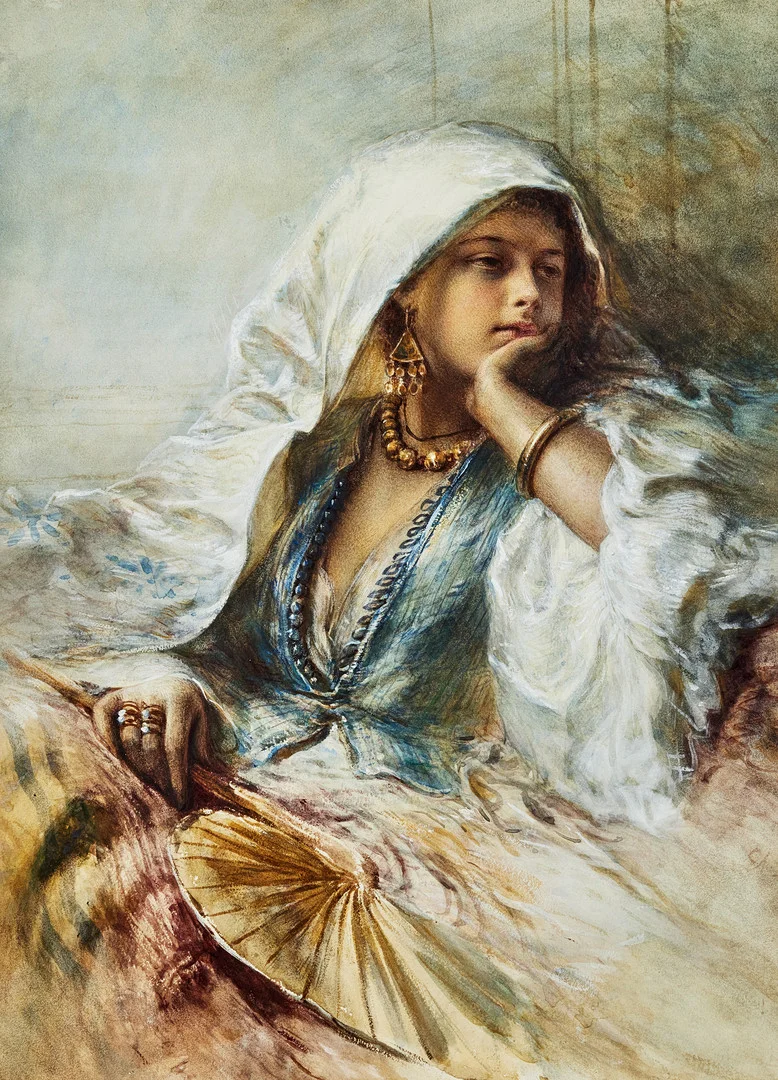
EGRON LUNDGREN 1815-1875 La Belle Sultane Signerad EL. Akvarell och täckvitt på papper, 46 x 34 cm. Påskrift i blyerts på baksidan 'The Sultana by E Lundgren'. ”The Sultana” Signed EL. Watercolour and bodycolour on paper, 46 x 34 cm. Inscribed ”The Sultana by E Lundgren", in pencil on the reverse. In a period gilt frame and gilt mount manufactured by W.H. Benn, Dealer in High-Class Pictures, 8, Cavendish Circus, Buxton, England, backboard in wood PROVENANCE William Walton (born 1832), Harrytown Hall, Romley, Stockport, England Fil. Dr Emil Hultmark (1872-1943); thence by descent to 2020 EXHIBITED Manchester, Royal Jubilee Exhibition, Manchester, 1887, No. 1166, lent by William Walton Esq. Stockholm, Kungl. Akademien för de fria konsterna, Emil Hultmarks samling, 1942, No. 128 LITERATURE K. Asplund, Egron Lundgren, Vol. II, 1859-1875, 1915, p. 162 M. Sterner, Fil. dr. och Fru Emil Hultmarks hem, Birger Jarlsgatan 32, Stockholm, in Svenska hem i ord och bilder, 1936, pp. 179-182, illustrated C. D. Moselius, Emil Hultmark som samlare och forskare, 1944, s. VII Professor Sten-Åke Nilsson, the co-author of S. Nilsson & Narayani Gupta, The painters eye. Egron Lundgren and India, 1992, consider the present work Lundgren’s best work of an Indian subject intended for sale (e-mail 5 June 2020). The picture was executed in England following the artist’s return from India in April 1859 and is based on a sketch drawn at the Indian court at Lucknow. Lundgren remained in England until the new year 1859. In 1857 Lundgren was commissioned by Agnews & Sons in Manchester to travel to India as war reporter in order to make a pictorial record of the Indian uprising against the English that had broken out the previous year, known as the Mutiny. Agnew & Sons had previously published a richly illustrated volume on the Crimean War, and planned a similar publication on India. Lundgren embarked on his journey to India in February 1857. Queen Victoria was particularly interested in India, and from her Lundgren received a commission for watercolors, which he dispatched to her at regular intervals. Lucknow was the capital of the Awadh region, controlled by the Delhi Sultanate and later the Mughal Empire. In 1856, the British East India Company abolished local rule and took complete control of the city along with the rest of Awadh and, in 1857, transferred it to the British Raj. Lucknow became a focal point for rebels angry at the inconsistencies in British policy and through the ’siege’ of Lucknow they attacked the symbol of British power - the Residency. The Indian uprising represented a watershed in British relations with India. As a result of the war the east India Company was abolished and India was granted Crown Colony status. William Walton, the first recorded owner of the present work, lived at Romley in Chesire. It is closely situated to Buxton where the maker of the present frame and mount had his business. Kompletternade bilder: Harrytown Hall, Romley, Stockport, England.