Avslutad
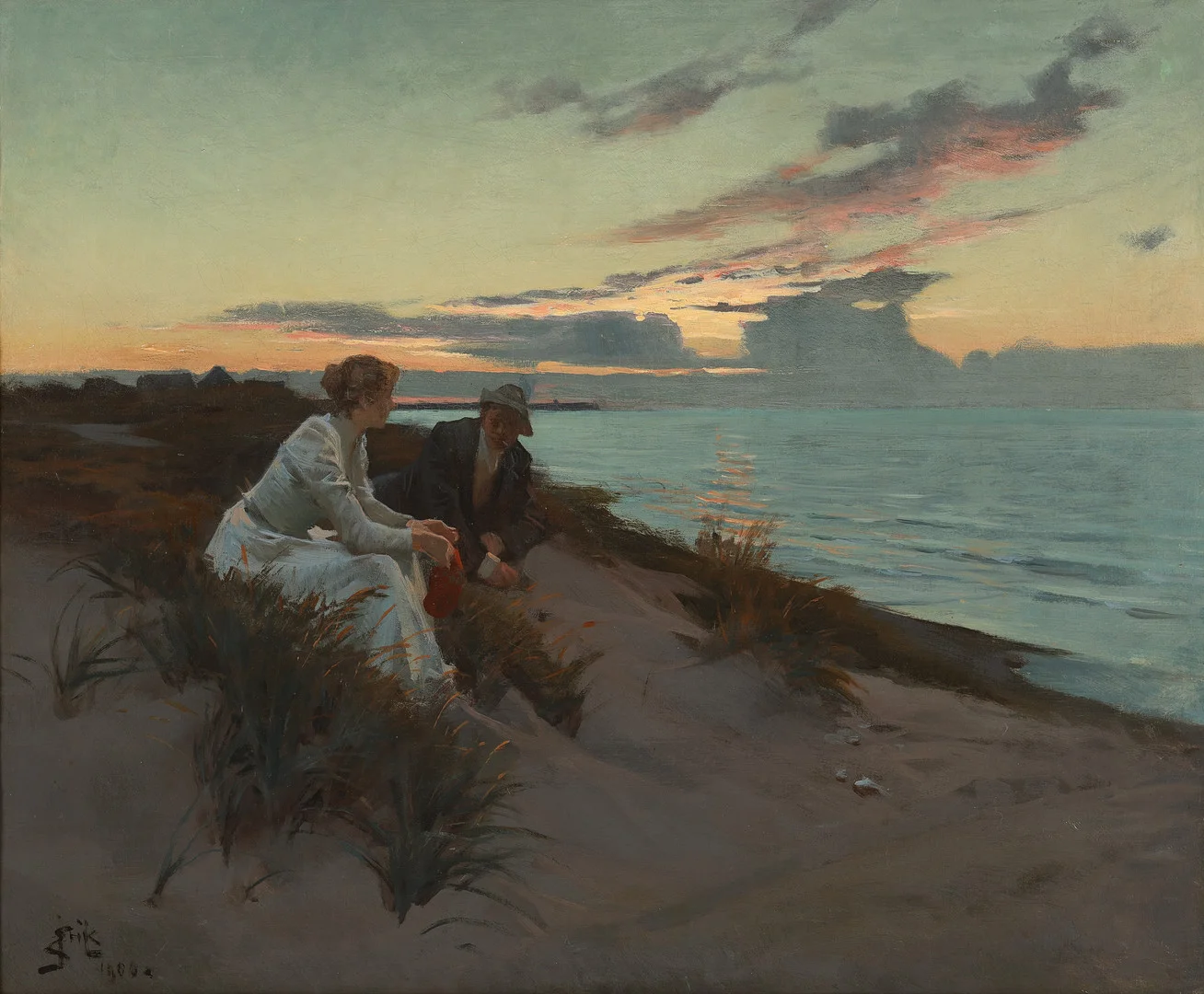
ERIK HENNINGSEN (DENMARK 1855-1930). Watching the sunset.
Erik Henningsen
·
Klubbat pris
310 000
Erik Henningsen
·
10 bud
Skick
Occasional craquelures, minor wear due to the frame. For further questions, please contact julia.sorling@auktionsverket.com.
Utläst automatiskt ur husets skickbeskrivning.
Oil on canvas, 63 x 75.5 cm, including frame 76.5 x 90 cm. Signed and dated Erik H 1900 lower left. With label on the stretcher: ”Erik Henningsen the Danish painter Peter Severin Kröyer and his wift Marie on a sand hill, Skagen". PROVENANCE Falkkloo's, auktion 30, 7 November 1995, lot 166. Erik Henningsen occupies a distinguished place in Danish art history as one of the foremost painters of the late nineteenth century, celebrated for his finely observed depictions of everyday life and his commitment to social realism. Trained at the Royal Danish Academy of Fine Arts in Copenhagen, Henningsen first gained prominence through his portrayals of working-class subjects and urban scenes, capturing with empathy and precision the realities of modern life in a rapidly changing society. Around the turn of the twentieth century, Henningsen’s artistic expression began to shift. His palette lightened, and his focus turned from social critique toward more intimate, atmospheric compositions. It was during this later period that he spent time in northern Jutland, where he came into contact with the famed Skagen painters’ colony. This group of artists — among them P.S. Krøyer, Anna and Michael Ancher, and Viggo Johansen — had, since the 1870s, gathered in the remote fishing village of Skagen, drawn by its unique coastal light and its blend of simplicity, community, and nature’s grandeur. Within this setting, Henningsen found new inspiration in the landscape and the subtle interplay of light and human presence. “Watching the sunset” exemplifies this evolution. The composition captures a moment of quiet intimacy: a man and woman sitting together watching the setting sun and contemplating nature and life. The golden tones and diffused light evoke the unmistakable atmosphere of Skagen’s late summer evenings, where sky and sea merge in an endless expanse of colour and reflection. In contrast to the sharper realism of his earlier works, this painting reveals a more contemplative and lyrical sensibility. The social observer has become a poet of light, exploring not the struggles of daily life but the timeless beauty of human connection within nature. The work resonates with the ideals of the Skagen school — naturalism infused with emotion and a profound reverence for the northern light.