Skick
Good condition. For questions, please contact lisa.mejeritcher@auktionsverket.se.
Utläst automatiskt ur husets skickbeskrivning.
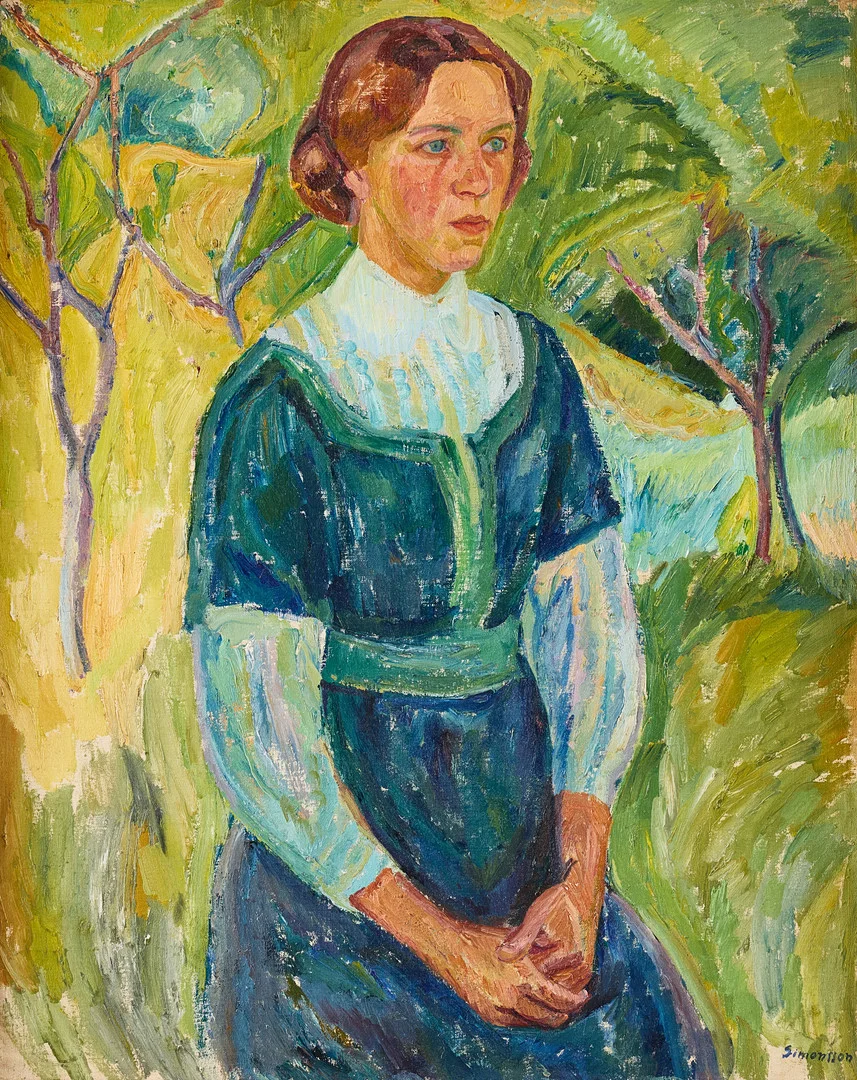
Oil on canvas 80 x 64 cm, including frame 109 x 92 cm. Signed Simonsson. Executed in 1909 according to a label a tergo. PROVENANCE The artist Birger Simonsson (1883-1938) The artist's widow, the artist Ingrid Simonsson (1885-1977) Their son Erik Simonsson (1924-2022) LITERATURE "Svenskt Konstnärslexikon" volume V, Allhems förlag, Malmö 1967, text p. 153: "One can also mention the portrait of Miss E., which in an exquisite way combines classical firmness in the composition with a luminous coloring that gives a fine taste of slumbering, faintly restrained passion." Stockholms Auktionsverk would like to express a warm thank you to Tor Simonsson, grandson of Birger Simonsson, for valuable help in the cataloging of this work. Birger Simonsson's portrait of a woman "Miss Elin Cervin" is a central work by the leader of "De Unga" (The Young Ones), better known as the "1909 men", executed in the important year 1909, when modernism had its breakthrough in Sweden. The painting depicts the 24-year-old Miss Elin Cervin (1885-1975), daughter of the banker and art patron Carl Cervin Jr. (1850-1919). Elin Cervin's upbringing in the affluent banker home in Stockholm was characterized by the family's role as art patrons, and she came to socialize with several of the foremost early Swedish modernists. The portrait of Miss Elin Cervin was executed in 1909 at the Sundsholm estate in Simlångsdalen in Halland, where Birger Simonsson painted that summer together with Isaac Grünewald, Sigfrid Ullman, and Knut Janson. It is on the same occasion that Isaac Grünewald executes his famous painting "Kamrater" (Comrades). The monumental painting, which is part of the collections at Prins Eugens Waldemarsudde, depicts Birger Simonsson, Sigfrid Ullman, and Knut Janson in life-size. Isaac Grünewald renders Birger Simonsson in profile standing in a solitary, self-confident pose to the right in the composition, which reflects Simonsson's role as the leader of the group. Opposite him, to the left, he places the two other artist comrades as a unit - Sigfrid Ullman with his arm resting on Knut Janson's shoulders. Birger Simonsson's portrait of Miss Elin Cervin and Isaac Grünewald's "Kamrater" exhibit compositional similarities. Both artists place the people in the foreground in a landscape where tree trunks interact with the individuals, while the absence of a horizon line and sky gives the paintings greater power and a stronger focus on color. In one respect, however, Birger Simonsson's painting appears more purely modern in its expression. While Grünewald - in the same way as many 19th-century painters - lets a path in the motif create a traditional sense of depth in the image, Simonsson suppresses all such tendencies in his portrait of Miss Elin Cervin. Instead, he renders the background landscape almost as a vertical, which reinforces the surface-decorative presentation. In that respect, Simonsson stands closer to Matisse here than Grünewald does, and not least when it comes to the background landscape, one can see a parallel to Matisse's painting "Branche de fleurs" from 1906. The much-discussed luminous coloring in the portrait of Miss Elin Cervin is also something that one associates with Matisse. In his presentation of Birger Simonsson in Svenskt Konstnärslexikon, Christopher Jolin highlights the portrait of Miss Elin Cervin as one of the pearls in the artist's production and describes how it "in an exquisite way combines classical firmness in the composition with a luminous coloring that gives a fine taste of slumbering, faintly restrained passion." It is an insightful description of a painting - which, despite its influences from Matisse - can also be traced to the portrait art of the Renaissance. One could actually go so far as to see the portrait of Miss Elin Cervin as something of Birger Simonsson's "Mona Lisa", and perhaps it is precisely the combination of echoes from the old masters and the modern mode of expression that lends the painting its greatness. The "taste of slumbering, faintly restrained passion" that Christopher Jolin notes gives the painting an additional dimension and also constitutes a basis for explaining the sincerity that characterizes the portrait of Miss Elin Cervin. In the card index preserved by the Simonsson family, it appears that she also figures in another work that Birger Simonsson executes at Sundsholm in 1909. It is in the painting "Tre flickor" (Three Girls), where the other two girls are the sisters Jane and Tyra Gumpert. Despite the passion that can be traced in the portrait of Elin Cervin, Birger Simonsson would meet his future wife Ingrid in Paris the following year. Birger Simonsson's and his comrades' joint working summer in Simlångsdalen in 1909 has been described in the following way by the proletarian poet Leon Larsson in his posthumous notes: "Anyone who superficially saw them and their summer days could easily be deceived and think that it was only play and jokes. But that was wrong; under the surface, it was toil and work and bloody seriousness. It was by no means butterfly play and pleasant pastime. I saw men in the bitterest poverty fighting an almost hopeless battle for misunderstood thoughts and incomprehensible painting ideals. It was a battle with clenched teeth and growling stomachs. But there was never any talk of bargaining and concessions. What they considered to be right, that was right. On that, there was no room for negotiation. There were no contortions, but the path was to go straight ahead. – These were the men of the new art." Leader of these "men of the new art" thus became Birger Simonsson. After only one term at the Artists' Association's third school, he had in the spring of 1906 - as the first of the students - traveled to Paris to seek new role models and impulses, which he then came to convey to his comrades back home in Sweden. Birger Simonsson, however, did not seek originality for its own sake but strove for a stable foundation of his own to stand on. Even though Birger Simonsson admired Henri Matisse both as an artist and as a teacher, there was something in his art that was alien to him. In Matisse's focus on formally innovative painting, something of the sincerity and sensitivity that characterizes Simonsson's more personally marked artistry was missing. His great role model was instead van Gogh, which is evident in a letter that Birger Simonsson wrote in 1909. There he describes van Gogh's art as "the most beautiful I have seen" and continues: "Matisse is an Olympian but van Gogh speaks to us humans; we surely understand him better." As the leader of the young modernists in Sweden, Birger Simonsson met strong resistance from an uncomprehending public and corps of critics, but he was a very skilled debater, who with his intellectual sharpness and strong conviction could plead the modernists' case in the fight for the new art. Simonsson's moral authority and absence of a need for self-assertion also came in handy when he tried to unite the often conflicting wills among the artist comrades in "De Unga". In time, however, some of the younger hotheads, with more pronounced needs for self-assertion, would come to appear as standard-bearers for the group in media contexts. Birger Simonsson's great importance as a pioneer for the breakthrough of modernism in Swedish art is, however, indisputable, and one of his foremost artistic contributions to this constitutes the portrait of Miss Elin Cervin.