Avslutad
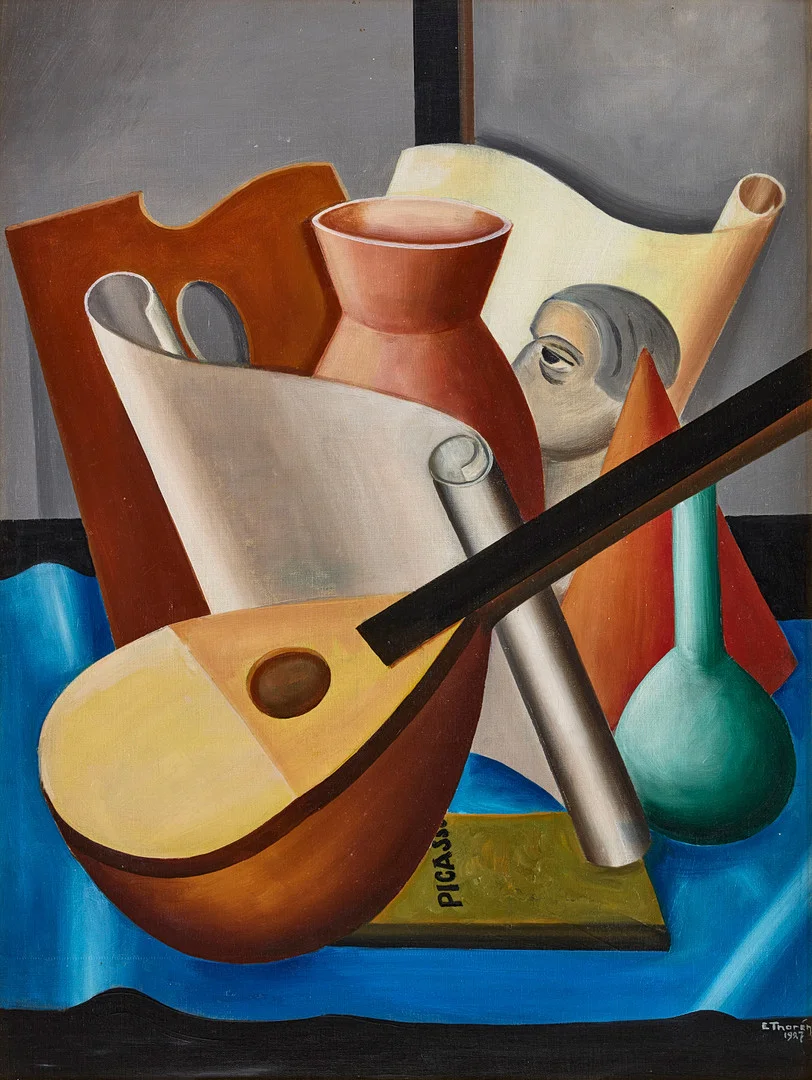
ESAIAS THORÉN. Still life with mandolin and Picasso book.
Esaias Thorén
·
Klubbat pris
420 000SEK
5 bud
Esaias Thorén
·
5 bud
Skick
Good condition. For questions, please contact victoria.svederberg@auktionsverket.se.
Utläst automatiskt ur husets skickbeskrivning.
Oil on canvas laid on panel, 66.5 x 50 cm, including frame 80 x 65 cm. Signed and dated E. Thorén 1927. PROVENANCE Bukowskis auctions, Contemporary and Design, April 2009, lot 53. From a collection of seemingly everyday objects, an image emerges where the world of the studio is transformed into a play of forms and rhythms. The closed Picasso book, a brown palette, the mandolin, and rolls of canvas or paper are gathered in a dense composition where each element seems to carry its own weight. On one of the curved canvases or papers, a painted profile appears – possibly Picasso himself – as a quiet echo of the artistic presence that permeates the entire motif. The softly rounded forms of the instrument and vessels meet sharper, more linear structures, and together they create an image where balance and tension interact. The perspectives are shifted, and a diagonal black line runs through the composition as a unifying force. Here, the objects are transformed from things into form – into parts of a well-considered and living whole. When Esaias Thorén painted Still life with mandolin and Picasso book in 1927, he was at a decisive stage in his artistry. The year before, he had traveled to Paris together with Sven Jonson, where they were strongly influenced by modern art and studied life drawing under Otte Sköld. The stay was short-lived, however, and in the spring of 1927, Thorén returned to Halmstad, where he and Jonson opened Modern Reklam, a combined studio and painting school that quickly developed into a hub for the city's artistic life. This particular period is characterized by intense experimentation. Thorén works in a post-cubist and purist idiom, where influences from the international avant-garde – not least Picasso and Léger – are translated into his own, more austere and constructive visual language. The still life becomes an ideal arena for these investigations: everyday objects are transformed into building blocks in a well-considered structure, where the relationship between form, space, and balance is at the center. The clear reference to Picasso in the motif underscores this artistic orientation. It is not a matter of imitation, but of a conscious dialogue with the language of modern art – where Thorén tests how far simplification can be pushed without the motif losing its identity. At the same time, one can already sense the sculptural weight and the interest in the object's presence in space that would be further developed in the following years. The painting thus belongs to one of the most vital and formative phases of Thorén's development – just before the formation of the Halmstad Group in 1929. It represents a moment where influences, ambition, and artistic clarity coincide, and where the foundation is laid for the expression that would become his hallmark for the late 1920s. As such, it constitutes not only an early and compelling work, but also a piece of particular significance for understanding Thorén's path into Swedish modernism. Has resale rights.